Part I
Italian Action in Political and Diplomatic Support to the Accession of Great Britain into the European Communities (February 1967 – December 1969)
Premise
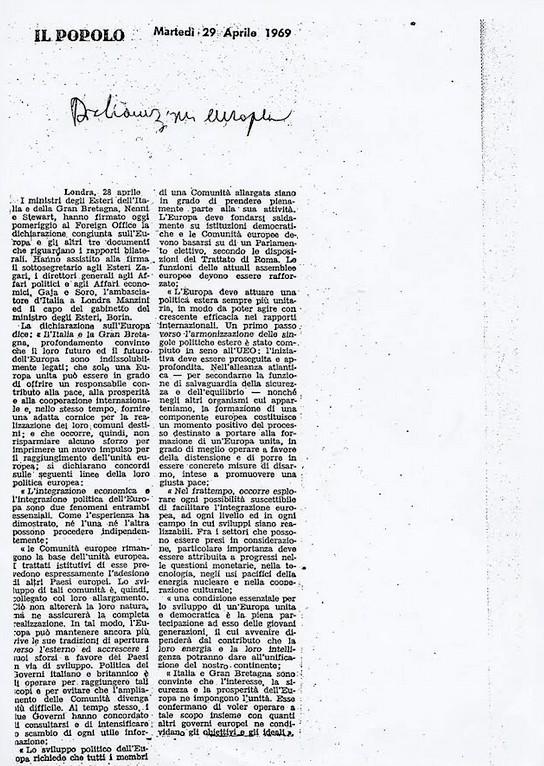
The precursors of the Anglo-Italian Joint Declaration signed in London on April 28, 1969 must be
sought and deepened in the political, social and diplomatic fabric that has brought together in
the same period of time the Socialist parties and in particular the Italian one, on the one hand,
and the British Labor party on the other. On the Italian side, Pietro Nenni was Deputy Prime
Minister in the I-II-III Moro Government (1963-1968) and then Minister for Foreign Affairs
(12 December 1968 - 5 August 1969); Giuseppe Saragat was President of the Republic (1964-1971);
Mario Zagari was Undersecretary of State for Foreign Affairs in the 2nd and 3rd Moro Governments
and in the 1st Rumor Government (1964-1969). On the English side, George Brown was Deputy Prime
Minister (1964-1968) and Foreign Secretary (1966-March 1968); Harold Wilson was Prime Minister
(1964-1970); Michael Stewart was First Secretary of State (1966-1968) and later Secretary of State
for Foreign Affairs and Commonwealth Affairs (1968-1970); Lord Alun Chalfont was Minister of State
in FO and FCO (1964-1970); Anthony Neil Wedgwood Benn was Minister of Technology (1966-1970).
A common feature was also full loyalty to NATO on the part of Nenni who, at the time of taking up
the office of Minister of Foreign Affairs, had obtained in Parliament the approval of the
interpretation he conceived since 1955 of the obligations assumed by the Italy with the Atlantic
Alliance according to which, underlining the defensive character, the Pact was an essential balance
factor for the security of the country and aimed at consolidating peaceful development in
international relations and starting the overcoming of the blocks.
Believing that the fundamental point that the Socialist Party should include in its program of
action was to strengthen an irreversible movement of public opinion (Government, Parliament,
workers and above all young people, industrial, agricultural and financial circles) in favor of
the entry of UK in the European Communities, the new head of the foreign ministry – Pietro Nenni -
had raised a question. What was the point - he asked himself - to continue talking about Europe if
the EEC were to remain restricted within the borders of the six founding states? and had declared
“to be prudent in indicating the first steps to be taken (among these would then be the
initiative of a joint Anglo-Italian declaration intended to pave the way for the accession of Great
Britain) but ambitious in indicating the goal to be achieved: a real political community capable of
giving a voice, face and strength to Europe in the world”. In his speech to the Socialist
Constituent Assembly of 30 October 1966, Nenni expressed himself with the following words:
“Either the economic organization of the Six Countries of the EEC extends to England and to
the countries of the free trade area and the Economic Community expands a political community or
even the results obtained can enter into crisis” and literally added: “there is not,
there is really not a single minute to lose!”.
In a speech in Strasbourg on Monday 23 January 1967, Harold Wilson pointed out that “no
statesman can hope to address the problems concerning both his own country and international
politics unless he is gifted with an imaginative sense of history”. With a conference held in
Rome at the Italian Society for the International Organization at Palazzetto Venezia on March 1,
1967, Sir Geoffrey de Freitas, a leading figure of the Labor Party, President of the Assembly of
the Council of Europe, said that, in keeping with tradition, a session of the Assembly had been
called so that Prime Minister Harold Wilson could explain to parliamentarians the new direction of
the British government towards Europe. After the speech given by Wilson, prominent members of the
Opposition, Sir Alec Douglas-Home and Duncan Sandys, taking part in the debate, made it clear that
Wilson had spoken on behalf of the whole of Britain and not just on behalf of the Labor government.
This was to demonstrate that the candidacy for entry into the Common Market responded to an
expectation of the nation without distinction of part. Geoffrey de Freitas specified that, in
Strasbourg, Wilson had definitively dispelled the doubts that could exist “by demonstrating
how the fate of Great Britain is linked to those of the European continent and how the trend of
events in recent years - the march of scientific and technological progress - has made it essential
for European countries to unite more closely if they want to maintain their independence and
promote their development”. He concluded by stating, referring to the timing of the
negotiation, “time is short but events are moving fast”.
On February 4 and 5, 1967, the IX Congress of the ‘Gauche Européenne’ met in Paris and
elected as President Sir Geoffrey de Freitas (President of the Consultative Assembly of the Council
of Europe as well as of the Labor Committee for Europe) and as Vice-Presidents Mario Zagari and
Karl Mommer (Vice President of the Bundestag). Pierre Mendès-France and Guy Mollet, unable to
intervene, sent messages. The discussion was opened by a report with which Jacques Enock,
‘socialiste de gauche’, affirmed that it was necessary to fight new nationalisms
encouraged by General de Gaulle and to make the socialist idea of solidarity among the European
peoples triumph. Mentioning the 10th anniversary of the Treaty of Rome, he hoped for both the entry
of Great Britain and the creation of a European assembly elected by universal suffrage. François
Mitterrand intervened with a warm and prolonged speech which formed the platform of the Congress.
“Technical problems” - he said – “are always solved when the political choice has
been previously established. This applies to the entry of Great Britain. If one does not intend to
make a political choice, even if the solution of technical problems is at hand, it will not be
done. Recent talks by British leaders in European capitals (allusion to Wilson's visits, starting
in Rome, in mid-January 1967 to illustrate the candidacy) are doomed to failure as long as it is
not changed French politics. Gaullist politics is harmful to the European construction and the
Gaullist notion of Europe must be firmly repudiated. For some years now a propaganda has been
developing in France which tends to say that the way in which the Head of State tackles problems of
Europe is more realistic, more effective and therefore more useful to the interests of Europe than
are the ideological conceptions of the specialists of Europe, of the European movements and above
all of the Gauche Européenne. This notion of Gaullist Europe which would be more in keeping with
reality and would move Europe more securely towards its destiny must be analyzed with precision. If
our analysis comes to establish that Gaullist Europe is harmful to the construction of Europe, then
this notion must be firmly repudiated. For me and for most of my friends Gaullist Europe is the
opposite of an independent Europe; it is the Europe of nations, each of which is destined to remain
subordinate to the imperatives of the two powers that currently regulate world equilibrium”.
This analysis by Mitterrand impressed the audience. In fact, a clear opposition of European
‘ideologies’ had emerged in Europe: on the one hand Gaullist France which denied any
character of supranationality to the Executive Commission and refused to access the development of
European institutions in this direction; on the other hand, the five member countries that made
support for the Commission a sine qua non for the further progress of Europe. The two
opposing conceptions respectively took the name of ‘Europe of homelands’ (Europe des
Patries) and ‘Europe of peoples’. Moving on to dealing with the application of the
Treaty of Rome, Mitterrand said that “the Treaty has not undergone changes; the rules are
applied in theory but at the cost of destroying the authority of both the Hallstein Commission and
the coherent core of power whose birth was imminent, that is a parliamentary control. We can affirm
that in this way de Gaulle set back the creation of a political Europe under popular control. Thus,
political objectives must be set so that an independent Europe with exactly opposite characters is
achieved, to those of a Gaullist Europe”.
The Congress closed with the approval of a final declaration in which “the European Left
solemnly declared that, since Great Britain accepts the Treaty of Rome and its implications for the
future political unification of Europe, the essential condition of its membership is satisfied and
consequently nothing should oppose its entry into the Community”.
On April 28-29, 1967 a meeting took place in Rome between a delegation of the Labor Committee for
Europe and representatives of the Italian Section of the European Left. This meeting was attended,
on the English side, by Norman Hart, John Hynd, William Edwards, Huge Gray, Dick Leonard, Norman
Haseldine and, on the Italian side, in addition to Mario Zagari, who introduced the debate, Altiero
Spinelli, Paolo Vittorelli, Fernando Santi, Carlo Mussa Ivaldi, Sisinio Zito, Margherita Bernabei,
Umberto Serafini, Gioacchino Albanese. Particular emphasis was given to the intervention of Altiero
Spinelli, author with Ernesto Rossi and Ursula Hirschmann between 1941 and 1944 of the
‘Manifesto of Ventotene’ (from the name of the island where they were subjected to
confinement), which was then published by Eugenio Colorni who wrote the preface.
Spinelli's reasoning opened with a double, positive premise. “First, with the Treaty of Rome,
it has been realized the most important and most qualified attempt so far made to overcome the
conception of nation states. Secondly, while 10 or 15 or 20 years ago it was difficult to find a
common language with Great Britain on European problems, we now have the same conception of
Europe, the same objectives. The difference from the past is that in 1962 Great Britain was deeply
divided while now a bipartisan policy is in place since the other large British party is also in
favor of membership. So the problem is not so much that of continuing to declare our faith and our
common beliefs but rather that of examining the difficulties that we will necessarily encounter in
the attempt to bring Great Britain into Europe and to develop European unity”.
Having made this twofold premise, Spinelli warned that “now, six years later, the Community
is in a difficult if not critical situation. There are contradictory implications in the Treaty.
The Community is something that can develop in a federal sense, or towards a simple league of
States or towards a simple community. This cannot be defined in the Treaty but must be done through
facts. If the appointment of the members of the Commission - since I believe that the Commission
represents the central point of the Community - will be carried out with men who are not of the
same stature or of the same authority as a Hallstein or a Mansholt, in short, if secondary officials
are used, the center of European action will undoubtedly be destroyed. At this point any form of
European Parliament would become useless, since the function of a Parliament is that of dialogue
with an existing power and if this power does not exist, Parliament becomes a simple forum for
academic discussion”.
The subsequent appeal that Altiero Spinelli addressed to the Labor Party congressmen is surprising
because later for various legislatures he became a member of the European Parliament influencing
the Single European Act and then founding the ‘Crocodile Club’. “It is now known”
- he said – “that de Gaulle's policy tends to debase the powers of the Commission and to
support the strengthening of Parliament, which should become the real center of the Community. In
this regard, you English might be tempted to follow a similar policy and this would constitute a
danger not only for Europe but also for yourselves. Italy has now given up any attempt to do
something serious in this field, assuming an even more negative attitude than the French one. So do
not aggravate the problem with your position”.
The veto opposed by General de Gaulle on January 14, 1963 to the entry of the United Kingdom into
the EEC was felt in Great Britain as an affront and in the Member countries as an abuse and aroused
a chorus of protests. But it should be borne in mind that General de Gaulle's veto was motivated
above all by the fact that France did not intend to join the multilateral atomic force that the
British and Americans had created in Nassau. On the French side, an association agreement with
Great Britain was not excluded from the outset with the aim of safeguarding trade. The year 1965
was announced, with the crisis resulting from the Hallstein Commission's own resources, as the year
of storms. In July France refrained from participating in the Council of the EEC by withdrawing its
permanent representative and limiting its Community activities to the management of current
affairs. Thus the Foreign Minister Maurice Couve de Murville continued the application of the lines
drawn by the French Head of State: to prevent Europe from becoming a region of the Atlantic area
with American hegemony and to prevent the ‘Brussels bureaucrats’ from assuming
supranational powers. Noting that since 1961 Great Britain had requested membership of the
Community, the ‘Six’ continued to weave the canvas in the WEU, of which Great Britain
was also part.
When Wilson formed the Cabinet after obtaining a narrow majority in the 1964 general election, it
persevered coldness for membership, England preferring the Protestant social democracies of the
Nordic countries and a free trade zone. It was George Brown, who served as Deputy Prime Minister
from 1964 and then as Foreign Secretary from 1966, who persuaded Harold Wilson - who was hesitant -
to place a new candidacy on May 10, 1967. There is a fundamental difference between the new
nomination formalized in 1967 and the previous application for membership presented in 1961. The
first candidacy aroused neither appreciation nor enthusiasm. London's refusal to join the European
Coal and Steal Community/ECSC was still alive; Churchill's words about Britain's ‘Atlantic
option’ rather than continental were still in memory; there was a suspicion in many that
England aimed more at destroying the Common Market than at actually entering it, or at least trying
to alter its structures and distort its spirit to avoid making a choice (between the Commonwealth
and Europe); it was feared that London would try to reconcile its residual imperialist interests
(still in 1960, half of British foreign trade took place with the Commonwealth countries and only
27% with Europe) and the desire not to be marginalized from the continent, without paying the
political as well as economic price. In short, there was a strong suspicion in many circles that
Great Britain was looking for in the EEC what the Commonwealth could no longer give it, without
however renouncing either its links with the ancient ‘dominions’ or ‘privileged
relations with the United States’.
The perplexities that emerged with the first request for membership were linked to the attitude of
Hugh Gaitskell who took over the leadership of the Labor Party in 1955 and maintained this
direction until 1963. Gaitskell opposed Britain's candidacy for the EEC introduced by the
conservative Macmillan in 1961 believing that the entry would lead to the breakdown of relations
with the Commonwealth. In a speech at a party conference in October 1962 he stated that the UK's
participation in a Federal Europe would entail “the end of Britain as an independent European
state, the end of a thousand years of history” and added: “You may say, all right! Let
it end! But, my goodness, it's a decision that needs a little care and thought”. The Labor
Party, then in the opposition, while not officially assuming a contrary attitude, made adherence
conditional on acceptance of Gaitskell's five conditions, namely: total autonomy in foreign policy;
autonomy in full employment policy; maintenance of an agricultural policy based on ‘deficiency
payments’; compliance with the commitments deriving from membership of the EFTA; defense of
links with the Commonwealth.
In the period following the French veto in 1963, the problems relating to the EEC were not touched
by British politicians. The conservatives had found themselves without any alternative solutions
and did not want to remind the voters of the slap they received with the 1963 de Gaulle veto. The
Labor leaders, after Gaitskell's death in 1963, were against resurrecting a program (entry into the
EEC) much discussed within the party, divided between two groups of equivalent weight, each of
about seventy personalities. So it was that there was no talk of Europe in the elections of October
1964 in which the Labor Party with 44.1 slightly exceeded the Conservatives who obtained 43.3 of
the votes.
The second candidacy was instead preceded by intense fervor for entry into the EEC, especially by
George Brown who had assumed leadership of the Labor Party following the untimely death, in 1963,
of Hugh Gaitskell. Harold Wilson, who had not sided with the opponents of the accession, as the
speeches made during the negotiations of 1961-1963 proved, with the support of Michael Stewart
eliminated, one by one, the five conditions of Gaitskell. Thus, a large part of the success in the
subsequent elections held in 1966, in which Labor with 47.9% of the vote and 363 seats could count
on a more solid majority, was due to the support for membership which had emerged during the
electoral campaign. Stewart, appointed foreign minister in the government led by Harold Wilson (the
Foreign Office had been in favor of membership since the first candidacy) then told the House of
Commons that the five conditions ‘were not the ten commandments’.
A first question: what attitude did Great Britain take after the elections in 1966 in view of the
renewed candidacy regarding long-term commitments? There was some ambiguity. A declaration in favor
of a future federal solution would have made British membership even more unacceptable for de
Gaulle, which explains Wilson's caution. On the other hand, it is significant that George Brown made
statements that resolutely aligned him in the federalist camp. The official position of the
conservatives consisted in the acceptance of a future politically united Europe. It can be said that
then no English government would have taken a dogmatic position, like the French one, opposed to a
possible step in the federalist direction nor would it have taken any initiatives on the subject.
The reconfirmed Premier Wilson was oriented towards following a pragmatic and gradual path, not
excluding possible forms of political integration in the European field. In February 1967 he stated
in Strasbourg - this was noted in the ‘European Initiative’, a Journal of politics and
economics directed by Mario Zagari - that “when such far-reaching issues are at stake (entry
into the EEC) for the future of Great Britain and all our countries, it would be a tragedy and a
discredit if this historic initiative were forced to get bogged down in a sea of details. We have
to keep up the momentum.”
A second question, always before the candidature for the entry of the United Kingdom into the EEC
was introduced for the second time: what contribution was Great Britain able to offer? The British
had chosen Europe for essentially negative reasons: the economic disadvantages of being excluded
from the EEC rather than the concrete advantages of membership; the danger of political isolation
from being ‘out’ rather than the role they could play within the Europe of the
‘Six’. Yet, the UK had a lot to offer at the time and both public opinion and government
circles were well aware of this in Italy. First: the accession of Great Britain would lead to an
effective democratization of the Community and to a strengthening of the European Parliament.
Second: Britain would bring with it a long and proven administrative tradition. Third: Britain would
add the experience of world problems and responsibility towards developing countries which are
shared not only in political spheres but also by British public opinion. So, in short, after the
entry of the United Kingdom and the other candidates, Europe would be more balanced, more
democratic, more sensitive to the possibilities that are opening up for Europe in the world.
Although this is a diplomatic initiative to be evaluated on a historical level, it would be worth
asking whether the implications of the ‘Anglo-Italian Joint Declaration’ on Europe
signed in 1969 do not merit in-depth reflection in the current European situation.
1. In a Conference delivered at the University of Reading on February 7, 1967, on the theme
'From a Little Europe towards a Greater Europe', evoking 'Thought and Action', the motto of the
Risorgimento that led to the unification of Italy and expressing the dominant thought of the
Italian Socialist Party, the Hon. Mario Zagari said that “Great Britain's entry into the
European Economic Community is feasible in the not too distant future, as the objective and
subjective conditions exist to overcome in a positive manner the remaining difficulties”.
With a letter of thanks dated February 14, 1967, Professor P.W. Campbell, Dean of Faculty of
Letters, stressed “your speech was a great encouragement to all of us who believe in the idea
of Europe and who are working to apply it in the fields of scholarship and policy alike”.
2. By letter dated February 13, 1967 addressed to the Minister of Foreign Affairs Amintore
Fanfani and by letter dated February 16, 1967 addressed to the Vice President of the Council Pietro
Nenni, Hon. Mario Zagari reported having had meetings in London on the occasion of the aforementioned
conference with various government personalities as well as with the main exponents of the Labor
Party. In those meetings Mulley and Thomson, Secretaries of State at the Foreign Office, had
instructed Zagari to renew the Hon. Nenni, also on behalf of Brown, the expression of their profound
‘gratitude’ - this was the word they had used - for the position taken by Nenni and
which he had tangibly expressed in favor of Britain's entry into the Common Market. They trusted a
lot in Italian support, and in particular in Nenni's personal support, so that in an upcoming
delicate phase the political and economic premises on which Harold Wilson had set his action could
be strengthened centered, precisely –as cornerstone of foreign policy- the British participation in
the European integration process. For any useful purpose, the Hon. Zagari forwarded a note dated 11
February 1967 to the Foreign Minister in which he emphasized that the British interest in the
developments of Italian life with particular regard to the social, economic, scientific and cultural
aspects was constantly increasing and that this interest was polarized on the short-term entry of
Great Britain into the European Community.
With another confidential memo dated February 13, 1967, the impressions obtained during the talks
held with the Ministers of State at the Foreign Office, Mulley and Thomson and with the Minister of
Technology Wedgwood Benn on the aforementioned topic were summarized: “I- Great Britain is
determined to join the European Community. This is a political will rooted in public opinion and
supported by an unavoidable need of an economic nature. Great Britain focuses its future on
industrial development that can only be achieved in a larger market, that is the European one. It
is a fundamental choice. The problem now is to implement it. II- The fundamental point is that of
technology. England is making a great effort to siphon the enormous scientific potential into the
industrial context. England is at the forefront in some sectors (aeronautics, atomic energy,
electronic computers); in some fields (see project for a swing-wing aircraft) the country is ahead
of its time compared to the United States itself. But the British economic space is too limited to
make such a transition from science to technology (Labor has created a dedicated Ministry of
Technology which also incorporates the development of the aviation industry). De Gaulle in Paris
hinted at Wilson about possible bilateral agreements in the technology field. In English thinking
these agreements can find fertile ground when it comes to making investments of a public nature as
in the case of the Concorde project and that of the ‘swing-wing aircraft’. But if you
want to frame the industries and private entrepreneurs and companies with state participation; that
is, if you want to set up a scientific and technological development policy, you need an
institutional framework and this framework can only be achieved with an enlarged European
Community. Zagari asks if Britain has set up a technology plan. Tony Benn replies that he is
reflecting on this problem but that a technological plan can be elaborated and eventually presented
only after the acceptance of a British application for entry into the Community. III- The monetary
problem is undoubtedly very important. But the British don't think it represents a ‘real
obstacle’. In 1963, de Gaulle did not raise the issue of the pound or veto the British
candidature for this reason. It is also in the Community's interest to use a currency on which 40%
of world trade now revolves. The real problem is that of the UK balance of payments which is
recovering and is expected to be in surplus next year. There are technical aspects to be examined
(with particular regard to the problem of sterling balances with the Commonwealth) but these are
obstacles that can certainly be overcome where there is good will on both sides. Once it enters the
Community, the UK economy will be at least as healthy as that of its other partners. IV- Attitude
with other countries. A) As for France, the version that Zagari had collected during his stay in
Paris has been confirmed, namely that de Gaulle would have posed the following perspective to
Wilson: a) ‘association’ (Wilson would have rejected this hypothesis); b) ‘Great
Britain in Europe means something different’ and it is on this ‘quid aliud’ that
the analysts of the probable evolutions of the General's thought are now focusing. B) As for the
Germans, Bonn would allow itself to be influenced by the conviction that in Paris there are the
keys to an improvement in Federal Germany's relations with the East. This, Thomson said, is a
mistake. France has nothing more to offer than any other European country can offer. In conclusion,
the central problem seems to be that of the calendar (of the ‘timetable’ as the English
say). The British believe that two weeks are enough to inform both the Commonwealth and the EFTA;
they are not in favor of pre-negotiation (a back and forth of the kind that Heath, as a negotiator,
did between London and Brussels would be deleterious and would expose Labor to constant
parliamentary questioning); the British are preparing themselves to submit their application
between May and June; some have wondered if the question should come even before the Rome
summit”.
3. The collaboration between Hon. Zagari and Tony Benn had the opportunity to be confirmed in a
subsequent meeting held in Rome on Tuesday 21 November 1967. With a warm toast at the end of a lunch
offered at the Hôtel Leonardo da Vinci in honor of the guest, the Hon. Zagari began by evoking that
“the explosion of the technological problem has had the same effect as a stone thrown into
the pond. Problems that were previously in a latent state raise concern today. A whole series of
questions have arisen: which type of society are we heading towards? What is the destiny of Europe?
If today we talk about the ‘technological gap’, this is referring to Europe. The one we
live in can be defined as the age of the continents, that is an age in which continental dimensions
are needed to keep pace with progress. Europe, which was the cradle of the machine revolution, is
now in danger of staying out of the computer revolution and nuclear civilization. That is why we
support and will continue to support Britain's entry into the European Community. A new ideological
content must be given to the European process. A united Europe must be a means of ensuring greater
breadth, greater well-being and above all a greater social and democratic elevation of those
categories, workers and young people, who until now have remained as spectators. We must say 'no'
to any form of nationalism, also rejecting a tendency towards European nationalism, that is, a
concept that is a prelude to protectionism and autarchy. We must say 'no' to any maneuver that
leads to forms other than the full adhesion of Great Britain to the Common Market, the simple
association being contrary to the interests of both Great Britain and member countries. So we need
to redouble our commitment so that, as advocated by Prime Minister Wilson, the course of the
accession negotiations is as rapid as possible”.
Kindly replying that Italy and Great Britain are guided by the same stars, ‘following the
same maps, to reach the same objectives’, the host pointed out that Harold Wilson had been a
convinced prophet of the technological revolution since he fought for leadership of the Labour
party. Wilson had made it a cornerstone of his government program and had become pro-European
precisely because of technology. The cordiality of the relations confirmed in Rome is reflected in
a warm message that Tony Benn sent to Zagari on 29 November 1967.
During the aforementioned visit Tony Benn held a conference at the Banco di Roma headquarters
having accepted an invitation from the Italian Center for Studies for International Conciliation.
Considering the importance that technology has had in Italian support for the British candidacy,
the lines of this conference are summarized. The starting point was the British government's
decision to devalue the pound. “The adoption of a new exchange rate, which is neither an easy
nor a pleasant decision, will eliminate any doubts about Britain's ability to accept the obligations
deriving from membership of the EEC and to play its full part within the Community. The results the
British Government expects from the restructuring of its industry begin to be evident especially in
the areas of advanced technology, such as computers, electronics, machine tools, atomic energy and
aeronautics. Devaluation is not a magic wand and nobody in the government has illusions about it.
We know that the possibility we have offered ourselves has a price but it is a price worth paying so
that the Labour Cabinet has unanimously chosen to take the path of economic expansion. Britain will
thus become much more powerful in world markets and at the same time a much more necessary and
desirable partner in the wider European Community that we are destined to build together. It would
be a grave mistake to suppose that Britain intends to accept anything other than full and complete
membership of the EEC. Far from diluting the Community, the British entry will strengthen it and
help give it the greater scientific, mechanical and industrial power it needs to establish itself
among the largest groupings in the world. British science is at the forefront as evidenced by the
fact that many Nobel Laureates in physics, chemistry and medicine have gone more to England than to
other countries comparable to Great Britain. But there is also the problem of the application of
science and this has become the central problem of British politics in recent years. It was the
current Prime Minister who, when in opposition, first emphasized, as a major political issue, the
urgent need to make technology a central issue in order to apply it more rapidly to industry. This
initiative became an important factor in the success of the election campaign. So that, as soon as
he became Prime Minister, Harold Wilson created the Ministry of Technology on whose tasks, with
reflections on education reforms and impact on the application for membership, Tony Wedgwood Benn
has long dwelt”.
4. During the aforementioned meetings and conversations - considering that it was necessary to
highlight in the Italian and English press the Italian support for the admission of Great Britain to
the European Community - Hon. Zagari (he had founded the monthly periodical ‘European
Initiative’) sent to various personalities of the Labour Party with government posts, articles
he signed and published by the newspaper ‘AVANTI!’ on 4 November 1966 with the title
‘Unification and Europe’, on 5 January 1967 with the title ‘European
Relaunch’, on 10 January 1967 with the title ‘The central point’, on 14 January
1967 with the title ‘Great Britain and the European Community’, on January 19, 1967 with
the title ‘Great Britain, Italy, Europe’. It is interesting to note the messages of
appreciation he received on such occasions: on February 13, 1967 from Harold Wilson, Prime Minister
who took the opportunity to thank the Hon. Zagari for the observations made by the latter on a
speech by Wilson himself in Strasbourg; on February 17, 1967 by George Brown, Deputy Prime Minister,
Foreign Secretary who appreciated the support of the Hon. Zagari to the English candidacy and was
delighted by the discussions that the Hon. Zagari had had with Fred Mulley, Minister of State in
Foreign Office and with Peter Thomson, Assistant Under-Secretary of State, Department of External
Affairs; on 8 February 1967 by Geoffrey de Freitas, Labor MP for Kettering, President Assembly of
Council of Europe, member of the Labor Committee for Europe who promised to resume contact with the
Hon. Zagari on the occasion of a visit to Italy at the end of February; on 10 February 1967 by Fred
Mulley, Minister of State to the Foreign Office with a handwritten letter whose text is transcribed:
“Dear Minister, it was a great pleasure to see you and have the opportunity of talking about
European problems. I hope we may meet again soon. I enjoyed very much reading your article and
speecch at Reading and very much agree with the line of your argument. I am sure you are right in
your assessment, as you put in your Reading speech, public opinion in this country has changed much
since 1963 and has 'discovered' the advantages of union with Europe. Thank you again for all you are
doing to help us and with all good wishes, yours sincerely Fred Mulley”; finally with a letter
dated 5 June 1967 from Edmund Dell, a staunch defender of the entry of Great Britain into the
European Community who, after having carried out industrial activities in the context of Imperial
Chemical Industries (ICI), had first been Parliamentary Secretary for Technology at dependencies of
Tony Benn in 1966 and then Under-Secretary of State for Economic Affairs.
5. Upon returning from missions carried out first in Asia and then in Poland, by letter dated 28
April 1967 Zagari reports to Nenni that he has had confirmation, as stated by Nenni himself to the
Socialist Constituent Assembly, that Europe must be created and there is no plus a minute to lose.
The same impression in New Delhi and Warsaw: we must focus on a united and democratic Europe in
order to strengthen peace.
As Zagari writes: “It seems to me that the problem of the formation of Europe with the entry
of Great Britain is the fundamental point on which we must fully push a policy of peace also in
terms of a solution to the Vietnam crisis. It is the only way if we want to move toward the
following purposes: a) to articulate a policy of conditioning of the United States which dangerously
rely in Asia on Japan alone; b) to address the problem of underdevelopment that has its epicenter in
India; c) to draw China out of its isolation, establish contact with it and find a way of
composition between the respective spheres of action”.
6. By letter dated 5 May 1967 the Hon. Zagari warmly thanked the Hon. Nenni for the intervention at
the breakfast offered in Rome to the Labour comrades, stating that “Nenni's presence had
acquired particular significance in the light of the presentation in those days of the formal
application of Great Britain to join the EEC” and that “Wilson's statements confirmed
what John Hynd, Norman Hart and the others told us, that is that while in 1961 the British demand
was set in an economic key, this time the British step was admittedly acquiring a political
value”... “In this situation” - the letter continued - “the position taken
by Nenni at the Socialist Constituent Assembly, intended to reiterate the urgency of the British
demand and the urgency of achieving an integrated Europe not only in economic terms but also and
above all with political purposes, was fully confirmed”. In this line of thought Zagari
concluded by hoping for a declaration by Nenni “as a premise of the Proceedings of the Round
Table held with the Labour Party, that would be published by the European Initiative
magazine”, journal patronised by the Hon. Mario Zagari himself.
7. With a further letter dated 25 July 1967 the Hon. Zagari informed the Hon. Nenni who, on the
basis of the indications of Nenni himself and in accordance with the aims and actions of the
Socialist Party, he had committed himself in recent months to two directions: that of the entry of
Great Britain into the European Community and that of the developing countries. It was a question -
stated Zagari - of setting up a campaign in depth on these two issues in order to highlight in front
of public opinion that it is we, socialists, who are carrying out - internally and internationally -
these two very important problems to which it is linked not just the construction of Europe but the
possibility for Europe itself to play a role in the world.
8. On 10 May 1967 the British Government formally submitted candidacies to the President of the
Council of the European Economic Community, to the President of the Council of the European
Community for Atomic Energy and to the President of the Council of the European Coal and Steel
Community, hoping that the application for entry of Great Britain was welcomed positively and
promptly, that an answer was given within a month and that a first negotiating meeting was held
within the month of July of the same year. On May 16, 1967 General de Gaulle during one of the
periodic press conferences at the Elysée issued a veto confirming the one he had already pronounced
on January 14, 1963. In his memoirs ‘Une Politique Etrangère 1958-1969’ Maurice Couve de
Murville writes: “Le 16 mai, dans sa conférence de presse, le Président de la République
rassemblait les données, en exposait les complications, les imbrications et les difficultés, pour
conclure que le choix était entre d'une part une accession comportant tant de changements et
d'exceptions qu'elle reviendrait à construire un édifice entièrement nouveau, d'autre part une
évolution, dont l'Angleterre commençait à montrer les signes, mais qu'il faudrait mener jusqu'au
bout, qui accomplirait la profonde transformation économique et politique nécessaire pour qu'elle
puisse réaliser sa jonction aux Six continentaux. En d'autre termes, pour la France rien n'était
acquis à l'avance. Il convenait de ne pas se hâter ni s'engager inconsidérément”.
Couve de Murville goes on to state: a) that the British immediately drew their conclusions from
General de Gaulle's press conference; b) that, being Paris reserved, indeed reticent, it was up to
the Five to force the hand of the French if not to force the doors. He adds, in caustic language,
that the English negotiator, Lord Chalfont, had launched a cavalry charge in an attempt to mobilize
members of the Community. Couve de Murville was right because in the following months the European
scene became complicated and in the context of the Five it was not possible to find a common
position. At the European Council in December 1967 Maurice Couve de Murville was adamant in
demanding that the recovery of the British economy be completed before the UK's application for
admission was considered. The Council could not help but take note of the lack of agreement, putting
in writing that the applications for membership of Great Britain, Ireland, Denmark and Norway
remained on the agenda. Federal Germany wanted the admission of Great Britain but did not want to
lose French support, which was necessary for the solution of the problem of German reunification.
The other four countries were in favor of admission, but more concerned with the internal
development of the Community than with its external enlargement.
Following strong pressure exerted on the German government by George Brown, then Minister of
Foreign Affairs, a division was determined, within the "Five", between Italy and the Benelux, on the
one hand, strongly oriented towards support for membership and the Republic German Federal, on the
other hand. At the Italian Council of Ministers of 26 June 1967, Nenni affirmed that British
accession to the EEC is a sine qua non to give Europe its prestige. “Europe will not
be built without Great Britain and Italy must not have any indulgence towards delaying maneuvers to
enter Great Britain from wherever they come”. In a speech delivered in Siena a few days before
the European summit convened in Rome for May 29, 1967, Nenni reiterates that “the Gaullist
opposition to the entry of Great Britain into the Common Market would have weighed like a boulder on
the aforementioned summit and that the slowness with which the enlargement proceeded would have been
evoked in the speech that the President of the Italian Republic would have made in the Capitol. The
summit was not announced in a positive light nor was substantial progress to be expected. This
caused concern since the accession of Great Britain was necessary and inevitable and any delay would
have been a factor of weakness for the whole of Europe”. The Dutch Foreign Minister, Joseph
Luns, declared in an interview with the weekly "L'Express", on December 5, 1967, that “we will
do everything we can to find compromise formulas that may be acceptable for France and Great Britain
but it is not completely excluded that at any given moment a choice will be imposed and it will be a
terrible choice. The European Community, after the imposition of a veto, would be condemned to
decline, perhaps to paralysis.”
With harsh language, Brown warms the atmosphere by declaring to the London press on 1 December that
“we do not accept the so-called alternative. We are not interested in the association. We are
interested in building, together with the other countries that are already part of it, a European
political community. The association formula would involve tariff agreements, at most. It is better
to drop the guillotine on any compromise solution.” On the same day George Brown declares at
the banquet of the ‘English Speaking Union’ organized in memory of Winston Churchill
that “Á l'avenir cette unité devra dépasser les limites de l'Europe Occidental, elle n'est
qu'un pas vers une Europe plus large. Cette unité permettra à l'Europe de faire entendre avec force
sa voix dans l'alliance atlantique et de contribuer plus effectivelyment aux besoins des pays en
voie de développement”. Lord Alun Chalfont, moving away from his measured style, abandons
himself to a shot of irritation by threatening a rethinking of the British ‘application’,
exclaiming: “But, let me stress, we are applicants, not supplicants”. Maurice Couve de
Murville, French Minister of Foreign Affairs, in the debates in Luxembourg expounds with utmost
clarity the theses and French concerns: “A Common Market of ten would alter the structures of
the Community painstakingly built in ten years of activity. The cohesion among the Six, achieved
with considerable efforts to adapt, would risk being canceled out with the consequence of
transforming the European Community, once enlarged, into a gigantic Atlantic free trade area. The
difficult balance that exists within the Executive Commission of the EEC and its own powers could be
seriously compromised by an enlargement that would make even ordinary administration more
difficult”. This discourse suggests what is the price that France is asking for allowing
enlargement of the Community, that is the elimination of supranational functions, the reduction of
the executive's power of initiative, the abandonment of the intentions of achieving a political
union. It is true that with his persuasive language Couve de Murville himself declares in an
interview granted to German radio on 12 November 1967 that “Britain's natural destiny in the
period in which we live is to get closer to Europe and finally to insert itself to Europe... The
Fouchet plan was not Germany or Italy but the other countries (the Benelux) who rejected it”,
then quoting the Augustinian aphorism in dubiis libertas, in necessariis unitas, in omnibus
caritas.
But this conciliatory language of Couve de Murville is not enough to reassure public opinion, which
is oriented especially in Italy towards full support for the British candidacy. Among the electoral
cornerstones, the Italian Prime Minister, Aldo Moro, includes European unity, stating on November
13, 1967 that “we need to take note of a new reality by inserting a concrete ideal among the
data of the political situation, an exciting goal towards which we must move with the right step,
tackling the problem of Europe's identity card”, while the most authoritative Italian daily
newspaper, ‘Corriere della Sera’, published on 22 October 1967 an editorial in three
columns signed by the special correspondent in London, Vittorio Gorresio, with the title
“Tomorrow the Six discuss the English question at EEC. A necessity for London; a good deal for
Europe”. It is worth re-reading this correspondence from one of the most popular Italian
journalists since it is a lucid analysis. The starting point was that “in England the
political will for entry into the Communities was sincere while this desire was more uncertain in
Europe since, while Italy and the three Benelux countries were frankly in favor, Germany hesitated
and France was against with the ancient and extreme distrust of General de Gaulle for the British.
The sincerity of the British was a forced choice due to the dissolution of the Commonwealth and the
loosening of the 'special relationship' with the United States. Harold Wilson loved to define
England with a hint of pride as 'the European pilot workshop' and for Europe it was a question of
whether the dowry that Britain brought offered convenience to marriage. Two risks were opposed,
namely that the imbalance of the British balance of payments and the instability of the pound would
burden Europe. These false problems and obstacles were invented for political convenience,
especially as a result of the opposition on the part of de Gaulle, whose policy was not only linked
to old themes (Trojan horse of the United States, incompatibility of character between the British
and the Continent) but it required to verify, in the name of the Treaties of Rome, the British
intentions so to ascertain whether they are not hiding a danger for community institutions”.
That marriage was profitable for Europe was underlined in an editorial in the 'Corriere della Sera'
of February 17, 1969 where Alfredo Todisco, a well-known writer and journalist, wrote that
“London, the great capital of advanced industrial civilization, is being cleaned up.
Ultimately, the well-being, prosperity and future of the country are based on the development of its
industrial and productive structure”. On the problem of the pound, Michel Debré, French
Minister of Finance, Economy and Social Affairs argued that before entering the Common Market,
England should have relieved itself of its function as an international reserve currency. The need
to defend the fixed exchange rate with the dollar (one pound against two dollars and eighty cents)
could have forced England to adopt protectionist measures incompatible with the rules of the Common
Market. Still on the subject of sterling, Brown stated on October 26, 1967 that “we do not
consider the pound an obstacle to our entry into the Common Market. In any case, if any of the Six
wish to propose reforms to the international monetary system, we are ready to discuss new ideas and
new formulas”. Since in the English government the firmness of George Brown's interventions at
the European level had raised some perplexity, he declared on November 2, 1967 with a speech in the
House of Commons that “our commitment to Europe is total and I think no one doubts our
sincerity anymore. The forces mobilizing in Europe in our favor do not gather against France or the
French government. France is no less essential part of Europe than Great Britain is. We must try to
build the house together”. Finally, the British acrimony towards the French Head of State was
expressed by the ‘Financial Times’ in the edition of 25 January 1967 with the following
words: “General de Gaulle appears to be casting Mr. Wilson in the role of Hercules cleaning out
the Augean stables. As soon as one lot of difficulties has been cleaned up General de Gaulle presents
a fresh one”.
That said, it may be useful to examine two documents mutually exchanged in the correspondence between Nenni and Zagari.
9. With a strictly personal letter dated 7 October 1967 the Hon. Mario Zagari thought it
appropriate to inform the Hon. Pietro Nenni about what had emerged from the EEC Council meeting in
Luxembourg in the previous days, even knowing that Nenni was about to leave for Zurich and limiting
himself to the truly essential points which, for convenience of explanation, are transcribed in full
below.
“A) - The meeting took place in a climate of softness and uncertainty which Schiller (German
socialist) and the representative of Bonn, Lahr, took advantage of to advance the thesis according
to which the merger of the three Communities (which, as you know, should take place within three
years) and Great Britain's accession should take place on parallel lines, indeed, 'the merger should
take place faster than accession.' It is clear that under such conditions the accession of Great
Britain is postponed sine die. B) - Faced with this maneuver, I was the first to take a
decisive position trying to straighten the boat: my intervention was reported in the press. I will
limit myself to adding that even the English newspapers (I enclose one of the clippings shown to me)
have given considerable prominence to our position. C) - I confess with the utmost sincerity that I
do not have any elements of judgment that would clarify the reasons for the German attitude. In the
corridors the hypothesis has been put forward of a compensation of mutual protectionist support:
French wheat against German coal. Somewhere it has also been thought that the Germans, in order to
obtain French support for their national problems, are willing to pay any price to de Gaulle on a
European level. The recent explanations given by de Gaulle to the German Ambassador in Paris about
the speech delivered in Silesia during his recent trip to Poland could reinforce this thesis. It is
certain that the German position took the British by surprise and this did not go unnoticed at the
Labour Congress in Scarborough. Under such conditions one gets the impression that very little can
be done with Kiesinger. Schroeder, who was rather pro-British oriented, is practically out of the
game. All that remains is to intervene on Brandt and explain to him well how things stand. The
opportunity presents itself in Zurich and that is why I wanted to write to you, I repeat, in the
impossibility of visiting you personally”.
10. With a subsequent letter dated 17 October 1967, always in a strictly confidential and
personal way, the Hon. Zagari informed the Vice President of the Council of Ministers Pietro Nenni
about the developments of the negotiations for the entry of Great Britain this time in the WEU
Council of Ministers held in the second week of October 1967.
“As you will have noticed in the press” - wrote Zagari - “I presented to the
Council of Ministers of the WEU in two separate interventions the point of view of Italy on the
problem of the Middle East and on that of Britain's accession to the Common Market. As regards the
problem of the entry of the United Kingdom into the EEC, it seemed appropriate to me, for the
purposes of a correct approach to the problem in the imminent decision to start negotiations, to
draw the attention of our partners to the need to split the strategic aspects of the problem itself
from those of a purely tactical nature. It is clear that British accession is of primary strategic
importance and qualifies as a large-scale political operation to be carried out with the utmost
urgency; any waste of time could be fatal not only for the future of Europe but also for the world
equilibrium and for the strengthening of peace in the world. Negotiations might be complex but we
must prepare to tackle them firmly and with the political will to overcome every obstacle. On the
basis of these considerations, I argued in London that the negotiations between the EEC and Great
Britain need to be started as soon as possible in the conviction that this historic opportunity to
favor the unity of Europe cannot be dropped. I would like to add that the London meeting of the WEU
showed, among its most significant aspects, a hasty retreat of the Germans from the positions they
had taken at the last Council of Ministers of the EEC in Luxembourg and of which I had informed you
with previous letter (letter dated 7 October 1967). This retreat, due in large part to our firm
action in favor of the British candidacy, could however only be provisional and a return of the
Germans to the positions previously assumed cannot be excluded. It will therefore be necessary to
continue to press on the Germans and in particular on Brandt so that at the next Council of
Ministers in Luxembourg the Community policy towards the British candidacy is definitively decided.
I wanted to make you aware of the foregoing so that you can draw useful elements of judgment, also
in the light of the conclusions of the Zurich meeting of the International in which you
attended”.
11. Relationships were very close on a personal level (thus the Hon. Zagari often talked with the
Hon. Nenni in the residence in Formia) and trust being placed in the work of Zagari who was often
entrusted with the leadership of the Italian delegation in the European instances, with a
handwritten letter addressed personally to the Hon. Mario Zagari on 19 October 1967 on
‘Council of Ministers’ paper (at the time he held the position of Deputy Prime
Minister), the Hon. Nenni, having followed the action carried out at the WEU by Zagari himself,
premised that he had said clearly to Brandt (Willy Brandt was Vice Chancellor and Foreign Minister
of the Federal Republic of Germany) and to have repeated on 18 October to Fanfani (Minister for
Foreign Affairs) that “we are going straight to a European crisis. It can erupt with Wilson if
we give the impression of seconding the French delaying maneuvers, or it can erupt with De Gaulle if
we prove otherwise”. Nenni went on to say that “Guy Mollet also agrees on this
point” (a lot of sympathy tied Nenni to the French politician who had participated in the
constitution in 1965 of the 'Federation of the Democratic and Socialist Left-FGDS' connected with
the 'European Left' led by Hon. Zagari). Nenni added that he had “naturally found a great deal
of understanding among the two Foreign Ministers (in reality these functions were only exercised by
Brandt at that time); I would not say that I have found the necessary political will“. Hon.
Nenni concluded with the following words: “a lot, in any case, depends on us. And we really
have to keep working”.
12. At the beginning of October 1967 there was a danger that General de Gaulle's veto would be
formally reaffirmed in the Council of Ministers of the EEC and it is to be assumed that this was the
concern of the European crisis evoked by the Hon. Nenni in the handwritten letter to the Hon. Zagari
of 19 October 1967. That this concern was shared in Italy at the government level is proven by a
declaration published in the ‘Corriere della Sera’ of 11 December 1967 according to
which the Hon. Fanfani (Minister of Foreign Affairs) replied to the US Secretary of State, Dean
Rusk, that “the Italian government is in favor of Britain's entry into the Common Market and
has no intention of bowing to General de Gaulle's diktat”.
The prediction of a crisis with serious consequences feared by the Hon. Nenni appeared to be well
founded because, as Jean-Jacques Servan-Schreiber declared to the press on 10 December 1967, “a
French veto in the EEC Council would have been absolutely unjustified as it was expressed not for
political reasons (Britain was certainly a democratic country) but on technical aspects that should
have been clarified in the negotiation phase that began with the renewed application for membership
by Harold Wilson”. So, concluded Jean-Jacques Servan-Schreiber, “it would have been a
politically excessive act”. That the aforementioned danger was concrete was proven by the fact
that in the Community context the French delegation had insisted on setting some conditions that
Great Britain would have to accept even before the negotiations had formally begun. This claim was
in contrast with the votes that took place in the Labour Party congress held in Scarborough which
represents a historic moment on the path of Europe. At that time it was confirmed that, as stated
jointly by both Brown and Wilson, “the problems relating to the entry of Great Britain into the
European Community are limited and solvable and there is nothing in the Treaties of Rome that is
impossible to accept by the British”.
13. The convergence of attitudes between the Labour Party and the Italian Socialist Party on the
problem of UK membership is reflected in the response that Zagari gave to Nenni's letter of October
19, 1967. With a letter dated October 26, 1967, the Hon. Zagari reported that a meeting of the
Movement of the European Left would have been organized in London by the Labour Committee for
Europe, similar to the one held in Rome in April at which the Hon. Nenni had attended by welcoming
an invitation to breakfast given to him by the Labour Comrades. On behalf of the members of the
Labour Party and the French members with whom Guy Mollet was associated, the Hon. Zagari addressed a
‘warm appeal’ to the Hon. Nenni, despite knowing ‘the amount of commitments’
to be faced in a delicate period of Italian politics, “so that he could find the time to lead
the socialist delegation to the meeting scheduled in London”. Moreover, in his capacity as
International Vice President of the European Left, Zagari informed “that he had already sent
an invitation to Ferri and Cariglia to be part of the Italian delegation and to reserve a similar
invitation to Brodolini and Cattani”. Finally, he took the opportunity to “send Nenni a
copy of a letter he had written to Ferri concerning a possible initiative of the Socialist group to
bring to Parliament the Resolution adopted in June by the Monnet Committee for the United States of
Europe”.
14. With regard to the ‘amount of commitments’ of Hon. Nenni, it deserves special
mention, considering the prestige of his work in the international field, a handwritten message by
him on 11 May 1967 to the Hon. Zagari who is transcribed below: “Mine is a daily struggle
between work and time, with work always losing. If anyone is able to reconstruct the few things I
said at the lunch offered to British friends, do it. I cannot. As for my support, it is
total”.
15. It is to be assumed that the vibrant concerns of Hon. Pietro Nenni, expressed in a handwritten
letter dated 19 October 1967 to the Hon. Mario Zagari, were subsequently strengthened by other
reasons. Referring to this letter, Hon. Mario Zagari pointed out with a strictly personal letter
addressed to Nenni himself on 11 November 1967 that “times are running out: Rey will be here
on Monday the 13th. On the 20th there is the Council of Ministers in Brussels” and added
“to consider his duty, on the basis of informations which he begged to be considered
completely confidential, to immediately point out that a formula was emerging that was summed up in
a 'special type of association' rather than Britain's membership”. Hon. Zagari stressed that
it was not excluded that the formula of a special type of association could lead to a crisis with
Wilson (a crisis that would drown Brown anyway).
In any case, "it would be a solution that would go against the creation of a great Europe,
democratic and economically and politically integrated. But even if we do not want to behave like
Europeans, it must be our duty to behave at least as Italians. This is why before going to Brussels
we must make clear those dangers and those damages, what a very high cost in short a potential
association (rather than membership) of Great Britain represents for Italy. If we did not make the
foregoing stand out clearly, our silence would be reproached (already 'Il Popolo' of 8 November
refers to a 'crisis of orientation of the European socialist forces') and - what is more important -
we would feel on us a bad conscience. We must therefore” - this is the conclusion of Zagari's
letter - “urgently bring the problem to the Council of Ministers with a view to defining a
clear line of conduct for the meeting in Brussels on 20 October”.
On the same date, November 11, Zagari sent Nenni a three-page memo in which he reported that
“the following formula is emerging on a German initiative, probably destined to meet French
favor: expert conversations between the EEC Commission and Great Britain, perhaps with the
procedural expedient of a 'supplementary investigation' to the Commission's report. The formula has
the following characteristics: a) objective: to avoid a break; b) short-term purpose: contacts with
Great Britain for a 'special type of association (the Commission is competent for associations, not
for membership); c) long-term purpose: English accession to the EEC; d) means: formal discussion of
the same substantial problems that arise for full membership which would appear, however, as a
simple futura spes.
The formula of the association - albeit disguised as a 'special type association' - presents for
Italy the following inconvenient: A) the associative solution would result in the granting of
commercial and tariff advantages to a series of highly industrialized and technologically advanced
European countries (Great Britain, Denmark, Norway) without these countries assuming at the same
time those obligations associated with membership (economic integration and implementation of
certain Community policies in the fields of agriculture, industries, energy, transport, scientific
and technical research, tax harmonization, etc.); B) an associative solution would be disadvantageous
for Italy since the agricultural sector would be excluded, both from the point of view of the new
outlet markets for our fruit and vegetables, and from the aspect of reducing our financial
contribution to the common agricultural policy, due to the English participation in it; C) the
association would be disadvantageous for Italy as it would favor bilateral (Franco-British and
Anglo-German) and triangular (mainly Anglo-Franco-German) projects in the field of the most
technologically advanced industries (nuclear, aviation, missile sector, computers). In other words,
the association would practically cut us out of the technology sector that represents the real
driving force behind the entry of Great Britain and would exclude us, given our lower economic
potential, from those combinations that would inevitably come about - for specific sectors and
projects - between France, Great Britain and Germany”.
16. This being the case, the Hon. Zagari instructed his Head of Cabinet, Mario Magliano, to
communicate urgently (this was carried out immediately with a letter dated November 16, 1967) that
"the Hon. Undersecretary before leaving for Lausanne had prepared an article for the newspaper of
the PSI-PSDI Unified, 'Avanti!', the text of which was enclosed together with a letter from the same
Undersecretary to the Hon. Deputy President of the Council". With a strictly personal letter dated
November 16, 1967, the Hon. Zagari communicated to the Hon. Deputy Minister Nenni “to have
seen how clearly and firmly Nenni himself had conducted the conversation with Rey about Great
Britain on November 14” and that “this attitude had led him to prepare an article for
'Avanti!' in a rather harsh tone which is part of our battle to reaffirm that the main road is that
of the economic and political integration of Europe with Great Britain as an essential component.
Shortcuts - such as that of any kind of association - would not only lead us to renounce such a
European process but would betray our own interests by placing Italy in an unsustainable position of
'European periphery'”. Since no corrections have been received by the Hon. Nenni, the text was
published in the form of a background article in the edition of 'Avant!' on 23 November, 1967 with
the following title in two columns: “Great Britain and EEC, MEMBERSHIP NOT ASSOCIATION”
and subtitle in four columns: “Britain's sense of responsibility at a time of crisis. Unions
and the party will support Wilson. This is the belief after the first contacts with the
representatives of the Trade Unions and after the meeting of the Labour parliamentary group. The
Prime Minister insists on joining the EEC”.
17. With an unencrypted telegram dated 15 November 1967, the Italian Ambassador in The Hague
informed that in an official statement the Dutch Foreign Ministry had declared that its Government
had learned with great satisfaction the declarations of Prime Minister Wilson regarding the
Government's intentions British to vigorously persevere in its efforts for stronger European
integration.
18. As evidence of the importance that Italy attributed to the problem of the United Kingdom's
entry to the EEC in the context of its international relations, it is of interest the letter dated
29 November 1967 in which Zagari referred to Nenni, in view of imminent meeting at the Checkers, on
the talks held in Warsaw in the days preceding the aforementioned date. During the visit to Warsaw,
three themes were touched: Vietnam, Great Britain, technological cooperation. As for Great Britain,
Zagari emphasized the guarantee that entry would offer in the face of the dangers of resurgent
nationalisms; on the need to foster that process of Europeanization underway in Great Britain which
would allow Europe to achieve real autonomy from the United States; on the progressive creation of a
great Europe of which, with the appropriate agreements, the Eastern countries could sooner or later
be part. “In April, my Polish interlocutors clung to the classic thesis (entry of Great
Britain into the EEC means greater protectionism and strengthening of the Western bloc). To my
surprise, this time the Poles listened to me with the greatest interest, without assuming a critical
attitude. As occurred in mid-November in Mitterand's visit to Prague, so in my visit to Warsaw it
became clear that the leaders of Eastern Europe are reviewing their positions on the issues of a
great Europe which are those of democracies, of development. technology and its weight in the world.
We should take this into account when drawing up our electoral platform”.
In a letter dated 4 December 1967 the English Ambassador to Rome Evelyn Shuckburgh informed the
Hon. Zagari: “I have heard from our Ambassador at Warsaw how very much he enjoyed the lecture
which you gave at the Palace of Culture and Science on 23 November, on the subject of East-West
technical and scientific co-operation. Mr. Thomas Brimelow has told me that he found your thesis
both interesting and helpful from the point of view of our common aims in Europe”.
19. Welcoming the renewed invitation of the Director of the newspaper 'Avanti!', The Hon. Zagari
reiterated his opposition to the association by signing an editorial on 6 December 1967 with the
following title in two columns: ‘The main road: full membership’ and a subtitle in four
columns: ‘In view of the meeting in Brussels where the entry of the Great Britain in the
Community will be discussed. Meeting at Palazzo Chigi for England in the EEC. Moro, Nenni, Fanfani,
Colombo, Reale, Andreotti participated. Today, at the Foreign Affairs Commission of the Chamber of
deputies, Fanfani intervention on European community policy”. The article underlined that
“Prime Minister Wilson and Foreign Minister Brown have said and repeated that any form of
association did not interest Great Britain which instead aims at building, together with the other
countries that are already part of it, a European Community based on economic integration with
political perspectives. Great Britain's will to fulfill its world function in European terms is
beyond question. This is increasingly evident not only in the declared intentions but also in the
facts, as evidenced by the measures taken in concomitance with the devaluation of the pound and,
ultimately, with the appointment of a pro-European of the caliber of Roy Jenkins to the office of
Chancellor of the Exchequer”. Lord Alun Chalfont, Minister of State at the Foreign Office,
expressed warm appreciation with the following letter dated 1 January 1968: "Thank you so much for
your letter of 19 December, enclosing the article you wrote in 'Avanti' on 6 December. I very much
agree with all you said, particularly about the fallacy of any 'half-way houses'. I was very pleased
that we should have taken part together in the Ministerial meeting of the Council of Europe earlier
this month. We deeply appreciate all that the Italian Government, and you personally, have done to
support our application for membership of the European Communities. I know how much the Foreign
Secretary valued the opportunity to talk over with our friends in Rome the new situation confronting
us”.
A similar appreciation was received by the Hon. Zagari from Evelyn Shuckburgh, British Ambassador
in Rome, with a letter dated 15 December 1967 of which the text is also transcribed: “Thank
you very much for sending me a copy of your article entitled 'The main road' which appeared in the
'Avanti!' of December 6. I was very impressed by the depth of the European sentiment which pervades
the views expressed in the aforementioned article, as well as by other statements of yours to which
my attention has been drawn. It goes without saying that my Government fully shares your conviction
that it is in the Europe's best interest that the negotiations for the full accession of Great
Britain to the Common Market begin without delay. In our opinion any further delay would only waste
precious time, both for Europe and Great Britain”. But the greatest appreciation from a
political point of view was expressed by the following letter addressed on 2 January 1968 by the
Foreign Office to the Hon. Mario Zagari, Under-Secretary, Ministry of Foreign Affairs, signed by
George Brown, then Foreign Minister, main architect of Britain's entry into the EEC: “My Dear
Colleague, I am very glad to have your letter of 19 December with the most helpful article you wrote
for 'Avanti'. Now that our application is for the moment blocked, we must all see how the damage to
Europe's interests can be minimized. It was a great confort to be able to talk over these problems
in Rome last weekend”.
20. With a personal confidential letter dated 13 December 1967 the Hon. Zagari informed the Hon.
Nenni, who still held the position of Vice President of the Council, that “while in Paris for
the meeting at the Ministers level of the Council of Europe, had read Nenni's declaration of 10
December in London on the problem of Great Britain”. Zagari added that he had reiterated, as
perhaps Nenni himself had already pointed out in the press, that “a possible veto in the
Council of Ministers of the EEC would certainly not have opened the way to resignation. But there
was one point that I would like to report you. In the conversation held in the afternoon between the
Ministers of the Council of Europe, on the one hand, and the parliamentarians, on the other, the
French Secretary of State Bettancourt gave the impression of being like Daniel in the lions' den.
The parliamentarians, and among them the Belgian socialist Bohy, have demonstrated the groundlessness
of the French position (recalling among other things the position of France in 1956) and have
leveraged the same point you raised, namely that 'Europe needs to unite and the world needs a
'United Europe'. In other words, the Gaullist position appears increasingly isolated not only in
Europe but also in France itself. It is therefore a question of strengthening that irreversible
movement of public opinion for adhesion. This is the fundamental point that the Party should
include, in my opinion, in its program of action”.
21. With a confidential-personal letter dated 24 February 1968 addressed to the Hon. Pietro Nenni,
Vice President of the Council of Ministers, the Hon. Zagari again referred to the handwritten letter
dated 19 October 1967 in which the Hon. Nenni wrote to him that he had told Brandt outright and
repeated it to Fanfani that we are going straight to a European crisis. Zagari points out that
“now (February 24) the most recent events give the impression that this crisis contains even
more serious unknowns and dangers than could have been imagined in October 1967. The elements on
which this appreciation is based are the following: 1) the front of the Five has shattered; 2) with
the declaration of February 16, France and Germany affirm that they want an 'independent' Europe but
restrict the prospects of collaboration with Great Britain to the commercial field; 3) the Germans
express perplexity for the British proposal for political consultations on defense issues.
An analysis of these elements raises the following questions: - why did the Germans get carried
away on a terrain that reduces the prospects for an agreement with Great Britain to mere commercial
aspects? - why did the Germans allow themselves to be induced to put aside the Benelux project which
meets the British theses on political issues? - why is Europe spoken of as an independent factor in
the world equilibrium when political collaboration with England is excluded? The first answer to
these questions could be that the Germans need France for the problems of the eastern borders. But
this answer is not convincing. Brandt himself points out that the new policy towards the East is
starting to bear fruit. Behind the German attitude there must therefore be something else that has
to do with the whole issue (political, nuclear and military) that revolves around the dispute over
the Non-Proliferation Treaty. In fact, it is known that Strauss's bad mood had skyrocketed. An
official statement from the C.S.U. (Christian Social Union in Bavaria) chaired by Strauss defined
the Russian-American text of the Non-Proliferation Treaty as 'unacceptable' days ago. This is why
there are talks about Franco-German collaboration, including that for enrichment. At this
point” - adds Zagari – “I must say that our memorandum to the EEC is well centered. In
this document, for example, the need to consolidate, in the nuclear sector, the foundations of the
common centre (i.e. European rather than national) is emphasized. But will our forces be enough?
This is why” - concludes Zagari - “it seems to me that the above discussion must be
carried forward, with strength and clarity, at the Wilson and Brandt level at the first opportunity
and in the forms that you thought appropriate to choose”.
22. In the memoirs of Couve de Murville it is emphasized that, despite the opposition of the
'Five' and above all of Italy, the Gaullist veto was confirmed in the Council of the EEC where "de
guerre lasse, on finit par arrêter la discussion". On December 19, 1967, the Council found that
there was no agreement to open negotiations with the candidate countries and decided that this
finding would be brought to the attention of the aforementioned countries. The matter would remain
on the agenda and each of the applicants could raise it again. Great Britain was thus confirmed that
the French attitude was negative for political reasons and not for technical or economic ones.
So, as a British negotiator observed, for Britain 'to keep momentum' might be fine but on condition
that to keep momentum was accompanied by a firm and unshakable resolution to keep the second
'application' on the negotiating table to months or years, if necessary, until the walls of Jericho
were torn down. Responding to a question from Edward Heath, leader of the opposition from 1965 to
1970, George Brown said that “the application for admission to the Common Market will be kept
in the hope that someday reason will prevail. It would not be in our interest that the Common Market
enters into crisis just at the moment in which we ask to enter it”.
On this line there was full consent on the Italian side. In an editorial in 'Avanti!' Of October 26,
1967 entitled “Great Britain in the EEC to build Europe”, Zagari wrote that “Italy's
attitude was not 'insaisissable'”, that is, elusive, ambiguous as stated in one of his article
by P.H. Spaak. Italy was convinced that Britain's entry was in the sense of history, having to think
in terms of Greater Europe and taking for granted a fact that would inevitably occur in the future.
“We are comforted by the growing support of public opinion and in particular of the working
classes as demonstrated by the document approved by the representatives of the 13 million workers
belonging to the International Confederation of Free Trade Unions, in which the need for a rapid
opening of negotiations with Great Britain is supported”. In France, voices of dissent about
the Gaullist veto were being heard. In the debate for the presentation of Servan-Schreiber's book
entitled 'The American Challenge', François Mitterrand and Valéry Giscard d'Estaing both argued that
the only way to meet this challenge was through the entrance of UK into the Common Market and the
creation of a minimum of European federal power. On 26 January 1968 François Mitterrand said that
“refuser une entente étroite avec la Grande Bretagne; refuser son entrée dans la Communauté;
refuser même la discussion avec elle, c'est la contraindre à resserrer ses liens avec
l'Amérique”.
The convergence in the support of the English candidacy was confirmed in a meeting in Rome on
November 18, 1967 between Nenni (who assumed the functions of Foreign Minister on December 12) and
Brown who had left these functions in March of the same year but persevered with vigor on the
parliamentary level in political activity; in that meeting the issue of European unity was deepened
in the awareness that without this union Europe has neither voice nor strength towards both the
USSR and the United States. Conversely, Gaullist firmness towards Great Britain was confirmed in the
French Council of Ministers where, on January 30, 1969, Michel Debré declared that “1969 will
be an important year, the year of a legal expiry. If our members believe that the Common Market
should not progress until England receives a positive response, a crisis of the Common Market will
evidently break out”.
23. Since the issue of Community enlargement remained on the agenda, Italy's position was again
illustrated by the Hon. Mario Zagari, in his capacity as Head of Delegation, in the session of the
EEC Council of Ministers held on 7 February 1969. Zagari stated that “this position is well
known and has not changed both in the principles and in the choice of methods to be followed to
facilitate future accession of Great Britain, Ireland, Denmark and Norway. For Italy there is no
real contradiction between internal development and the enlargement of the Community. It is not
possible to separate the process of internal strengthening from that of the progressive and
harmonious insertion into the community context of those countries which, due to the nature of
their internal systems, historical and geographical vocation as well as democratically and
repeatedly expressed will, are indissolubly carried to be part of it. Nor, in our opinion, is the
assertion that, expanding the Community, its nature and character would change. On the contrary, we
believe that only through its enlargement, the Community can maintain its nature and character and
can acquire new elements of dynamism necessary to make it fully achieve the economic and political
objectives of democratic unification of Europe set by the Treaties of Paris and of Rome. Only a
Community enlarged to include the United Kingdom and the other States that have applied for
membership can continue to assert itself on the world level as an effective instrument of general
expansion of trade, of international detente and of solidarity towards developing countries. We
prefer the immediate opening of negotiations. Such immediate opening would make it easier to focus
on the problems inevitably connected with accession and would constitute a more secure test bed of
the European vocation of present and future members of the Community. Nonetheless, aware of the
difficulties inherent in a process of such vast historical significance, we have always supported
and continue to support the opportunity for partial, but not temporary, links to be established
between the Community and the candidate countries for facilitate future entry. In this conviction we
are comforted by the fact that other countries of the Community share this point of view. We hope
that between us and these other countries there will be fruitful emulation of initiatives to jointly
seek the most suitable ways to establish such connections. Future accession may be facilitated by
technological cooperation and commercial 'arrangements' mentioned by the French Minister of State
for Foreign Affairs Jean de Lipowski but on condition that these initiatives are placed in the
perspective of the enlargement of the Community”.
24. The resignation of General de Gaulle, given on April 28, 1969, opened a new phase in the
negotiations for British accession. With the resignation of the French Head of State a question
arose not only in France but throughout Europe. Was the decade of General de Gaulle's government
(1959-1969) characterized by full independence from the major world power, the United States, only a
spectacular and satisfying episode for the prestige of France or a model to be extended to the whole
European arc? An answer is offered precisely by the Anglo-Italian Joint Declaration on Europe,
signed on the occasion of the visit of the President of the Italian Republic Saragat to London on
April 28, 1969 (the same day as de Gaulle's resignation), which is the subject of this essay.
In this Declaration it was –verbatim- stated that “a first step towards the harmonization of
individual foreign policies has been taken within the WEU (Great Britain was part of the WEU) and
the initiative must be continued and deepened” by adding that “in the Atlantic alliance
the formation of a European component constitutes a positive moment in the process destined to lead
to the formation of a united Europe”. After the riots of '68, the failed referendum on the
decentralization of the Fifth Republic and especially after the resignation of de Gaulle, the new
President -Georges Pompidou- believed that France, weakened by the crisis, was no longer able to
oppose and so removed the veto which had hitherto prevented the entry of the United Kingdom into the
Community.
During a visit to Belgrade on June 6, 1969, Nenni said he did not believe in Gaullism after de
Gaulle. At the 'Labour Party Conference' in Brighton, on September 30, 1969, Wilson delivered a
challenging speech centered on Europe. “Labour is changing Britain. We are promoting change.
The oppositon: the champagne corks had been popping. Now, as Britain moves from long years of
deficit into surplus, their champagne is turning into gripe waters. 'Bonum Patriae, Conservatoribus
Pessimum'. If they stop telling lies about us, we will stop telling the truth about them! New
calculations in agriculture and the cost to Britain's balance of payments; developments in
agricultural prices, capital movements, trade balance. Our statement of July 4, 1967 on Europe (this
is the program that Brown submitted to the WEU) remains subject to changes made necessary by the
passage of events (evident allusion to the resignation of General de Gaulle). We no longer face the
challenge of Europe cap-in-hand. Europe needs us just as much and many would say more, than we need
Europe. Broader perspectives of industrial change; we shall be increasingly concerned with
investment in human being as well as investment in technology”. At the end of November 1969
Wilson expressed the hope that “the negotiations will be swift and concentrate on the major
strategic problems, the minor issues being able to be resolved at a later stage, after the entry of
Great Britain into the Communities” and stressed that “the regulations approved under the
Treaty of Rome would have formed an object of negotiation, including the policy of agricultural
prices”.
Speaking of agriculture, with an editorial dated 1 December 1969, the weekly 'L'Express' with the
title 'L'Europe débloquée' pointed out that “the signing of a financial regulation concerning
agriculture was the price imposed by the French government to lift the Gaullist veto on British
accession”. In December 1969, in the course of a debate on Europe in Grenoble, Pierre Mendès
France, whose prestige remained intact in the socialist circles that later in 1981 would have
brought François Mitterrand to the Presidency of the Republic, pronounced an intervention that
helped to create detente in relations between France and Great Britain: “Dès 1958, en France le
problème de l'Europe n'a été vu que du côté purement juridique. C'était un faux débat. L'Europe oui,
mais au service de quoi et de qui. Quel type de société pourrait-on faire prévaloir, quel genre de
vie ou de civilization veut-on atteindre? Il s'agit de les définir au niveau national pour dialoguer
avec nos partenaires, chez lesquels on trouve les mêmes préoccupations. L'Europe s'exprime partout où
il ya un intérêt commun social, économique, financier qui se pose à un certain niveau au delà des
frontières nationales. Il n'est plus question de faire disparaître la nation; toutefois, si l'on veut
que les accords pris ne soient pas de nouveaux compromis, il faut au centre une autorité souveraine
qui soit l'émanation des peuples, un pouvoir politique qui décide et fasse appliquer les décisions.
L'Europe marquera une prise de conscience, une rééducation civique des membres de chaque Etat”.
Part II
Diplomatic Action in View of the Anglo-Italian Joint Declaration of April 28, 1969
Premise
The diplomatic action that would have led to the signing of a ‘Joint Declaration’ by
the Foreign Ministers of Italy and Great Britain, Pietro Nenni and Michael Stewart, in the Foreign
Office on the afternoon of April 28, 1969, was preceded by repeated interventions by the Hon. Mario
Zagari, Undersecretary of State for Foreign Affairs at meetings and debates on Europe.
During a discussion on the issue 'Europe and the United States' promoted on May 12, 1966 by the
'Centre d'Etudes de Politique Etrangère' in Paris and by the Italian Society for the International
Organization (SIOI) in which government figures participated, it was affirmed by the Hon. Zagari
that “the process of European construction on true democratic values presupposes the direct
participation of those powers, such as Great Britain and the Nordic countries, which are capable of
contributing decisively to the affirmation of a Europe on an effective democratic basis. It is above
all for this contribution and for this charge of democratic values that we must fully support, even
if it should cost us some contingent sacrifices, the entry of Great Britain into a greater
Europe”.
In a debate promoted in Florence by the Hamilton Foundation on April 13, 1966, the Hon. Zagari was
invited to deliver a speech, which was widely reported in the press, on the issue: 'Crisis of the
Common Market and Great Britain: consequences and prospects for the construction of Europe'.
“Il existe” - stated Zagari -“un concept gaulliste mais il existe aussi une
nouvelle situation politique, réelle, sur la base de laquelle nous devons agir, nous aussi. Bref:
cette situation nous indique que l'Europe des Six, née et développée en une certaine situation
européenne et mondiale, atteinte aujourd'hui par une crise qui frappe ses structures institutionnelles
et ses buts politiques, ne peut songer à revenir simplement à la situation -déjà lourde de crises-
d'il ya un an ou quelques mois. Une discussion politique a été entamée entre les Six. Elle sera
longue et scabreuse. Le processus d'intégration de l'Europe doit s'ouvrir à la Grande Bretagne et
aux pays du Nord de notre Continent. C'est là, du reste, le point de vue que l'Italie a toujours
soutenu puisque nous avons toujours conçu l'union des Six comme un élement propulseur, comme un
'modèle ouvert', destiné à attirer autour du noyau des Six tous les Etats et les peuples européens,
porteurs et protagonistes des idéaux démocratiques et de la liberté”.
On May 9, 1967, the Hon. Zagari was invited to open with a lectio magistralis the seminar
on the entry of Great Britain into the Common Market organized by the Institute of European
Community Studies of the University of Pavia. This was an opportunity to draw up an analysis of the
obstacles that had stood in the way of Britain's participation in the Common Market since the
beginning. The causes had to be sought in a series of reasons of both a political and economic
nature. On the political level, Britain could still consider itself a power capable of playing a
world role in the 1950s. The structures of the Commonwealth were still intact and this produced in
public opinion and among political leaders a certain reluctance to link up with other European
countries in a process of integration. Nor should it be forgotten that the signing of the Treaties
of Rome was the culmination not only of a negotiation between Governments but also of a whole
theoretical approach conducted by the numerous opinion movements (first of all the 'Ventotene
Manifesto') which saw in the economic integration the first step towards a federal union of European
countries. This was undoubtedly a hindrance to British participation. From an economic point of
view, Great Britain seemed rather oriented towards the free trade area rather than towards a common
market. The free trade area, as is well known, does not provide for the establishment of an
external tariff while it provides for the abolition of customs tariffs. Such a conception allowed
Great Britain to keep intact relations with the Commonwealth.
In 1961 Great Britain applied for membership. How had the situation changed so much that such a
decision was brought about? It is believed that the three years of existence of the Common Market
had dispelled many of the British doubts about the chances of successful integration. This positive
assessment was accompanied by the first signs of a weakening of the British world role. To all that
were added internal difficulties of an economic nature.
Moreover, as Guido Colonna di Paliano, Commissioner for the Internal Market in the Hallstein
Commission, observed in a report published by the Journal 'European Initiative' in January 1967,
“Great Britain, despite being very advanced in research and technology, could not make full
use of this relative advantage in technology in industrial and commercial terms because, remaining
outside the Community, the outlet markets to which it has direct and unhindered access are not
sufficient”. In a conference organized on February 21, 1969 by the Italian Democratic Union of
Company Managers (UDDA), it was emphasized that a pro-European initiative meant calling on new
forces, new concepts, new institutions, having to take the path of political, economic and social
integration of the member countries.
These concepts were developed in a speech at the session, on 22/24 March 1969, of the Central
Committee of the Italian Socialist Party (P.S.I.).
Taking stock of the 'European Community ten years later' in April 1967, Giuseppe Petrilli,
Commissioner for Social Affairs in the Hallstein Commission, stated: “The major issues of
European planning, common technological policy, Britain's accession to the Community - which today
seem ripe in the first place in the conscience of British public opinion - represent so many
deadlines the European ruling class will not be able to escape from in the near future. In this
context, many problems that today seem to be relegated to the limbo of good intentions - such as
that of a real representation and authority of the European Parliament - will acquire new relevance.
In the meantime, it is necessary to continue firmly on the path undertaken, mobilizing all the living
forces of our countries to awaken democratic public opinion, verifying, from the facts, in constant
adherence to the problems that are proposed to us by historical experience, our fundamental
persuasion according to which the Europe of tomorrow, to be free, must be federated”.
The presentation to public opinion of the aforementioned line of action found ground in the
publication, in April 1968, in the ETAS KOMPASS publishing series, of the book 'The European
challenge' compiled by Mario Zagari in close collaboration with Counsellor Mario Magliano, then Head
of the Cabinet of the Undersecretary of State for Foreign Affairs.
The Anglo-Italian Joint Declaration, intended to be signed on the occasion of the State visit to
London by the President of the Italian Republic Giuseppe Saragat, was based on the assumption that
“the transition that was imposed without delay from small to large Europe could not be
achieved if the fundamental prerequisite had not been created, namely the entry of Great Britain
into the European Communities”. This assumption was advocated by the Hon. Pietro Nenni who,
succeeding the Christian Democrat Hon. Amintore Fanfani, had assumed the office of Minister of
Foreign Affairs with the coming into operation, on 12 December 1968, of the government chaired by
the Christian Democrat Hon. Mariano Rumor.
1. The elaboration of the Joint Declaration began with conversations between the Hon. Zagari,
constantly flanked by his Head of Cabinet, and Lord Alun Chalfont, Minister of State at the Foreign
Office. It was necessary to prepare something new, that is a text that, without flag waving to the
four winds, would make clear the will of the two governments to support the enlargement of the
Communities with the entry of Great Britain. The starting point was the interview of 22 February
1969 in the newspaper 'Il Messaggero' with which Lord Chalfont had referred to the 'statement' of 4
July 1967 to the WEU by George Brown, Deputy Prime Minister (1964-1968) and Foreign Secretary
(1966-March 1968), advocating the accession of Great Britain to the European Community. With this
'statement' George Brown had argued, in harmony with the position of Pietro Nenni, that “the
Community is a dynamic and constantly evolving body. If it remains faithful to the spirit of the
treaties, it will continue to develop and its activities will extend to unforeseen sectors. The
Community”, Brown specified, “is capable of expressing its point of view and exerting
influence in world affairs, not only trade and economy but also politics and defense. It was this
interpretation of potential European development” - thus concluded George Brown's 'statement'
- “which more than any other factor has provoked the wish to join the EEC”.
2. The starting point was the WEU Council which met in Luxembourg on 6-7 February 1969 where the
Italian delegation was chaired by the Minister of Foreign Affairs Pietro Nenni flanked by the
Undersecretary of State Mario Zagari. “The Foreign Ministers met in Luxembourg for the WEU
Council to discuss the Italian paper on political cooperation. Gaston Thorn, Luxembourg new Foreign
Minister, reported that France had effectively told the Five on 1 February that 'the children had
now gone far enough'. De Lipowski, while hinting that France might agree to the need for improved
political cooperation within WEU, had instructions not to participate in a discussion or vote on the
Italian paper, and the Germans were unwilling to go further than the French. The meeting lasted over
six hours, partly because of French attempts to bog matters down in procedural discussion, but the
Five held together in support of foreign policy cooperation. Nenni introduced his paper, saying that
WEU could make a real contribution to European integration. There followed a long and acrimonious
discussion, in which Stewart proposed a first meeting to discuss the Middle East, and where the
isolation of the French became increasingly apparent”. (…). “The United Kingdom, Italian
and German delegations agreed with the proposal of the Benelux Government for a consultation in the
WEU before taking any decision on a list of foreign policy. The French delegation took note and
reserved its position on all matters of substance and procedure arising from the Benelux
proposal”. (…). “After the meeting, Stewart and Nenni discussed tactics. Nenni expected
Brandt to take an increasingly firm position, partly for electoral reasons (Federal German elections
were scheduled for the autumn). Meanwhile, although he was not prepared to upset the Common Market,
Italy would not support any decision that served French interests, including those on agriculture,
as long as France continued the veto. When President Saragat visited London in April there should be
a joint announcement of all that the British and Italians were doing to show that they 'saw eye to
eye' on the future of Europe. Stewart agreed”.
In the Council session, Pietro Nenni admonished –verbatim- that “if we do not have the courage
to reach concrete forms of political integration, then the process of economic integration will
also be blocked precisely when it is making Europe a determining factor in the world economy”.
Expressions of praise were addressed to Pietro Nenni by the President of the session Gaston Thorn
who appreciated the clear and enthusiastic presentation; by the Belgian Foreign Minister Pierre
Harmel who underlined 'immense youth of mind and breath of political initiative that had torn the
WEU from immobility and sclerosis'; by the Dutch Foreign Minister Joseph Luns who attributed to
Nenni the merit of having strengthened political cooperation and of having clearly established a
list of subjects on which decisions had to be made.
3. On the basis of the agreement highlighted at the WEU Council, the dialogue between Lord
Chalfont and the Hon. Zagari found fertile support in the action of impulse offered by the
Ambassador of Italy in London, Raimondo Manzini, who took up his duties on December 15, 1968. The
Embassy was the pivot on which it was articulated on March 6, 1969 a series of meetings and
exchanges of convivial views also extended to personalities from the cultural world (the sculptor
Henry Moore and the director Giulio Donnini were present at a breakfast) during which, always
figuring Lord Chalfont as primary interlocutor, they had the opportunity to intervene members of the
British Government and Parliament. “The leap in quality that Wilson wants to make English
society to achieve greater productivity” was praised by Giorgio La Malfa in a press conference
held at the Italian Embassy which was attended by various Italian politicians including the Hon.
Giovanni Malagodi, the Hon. Carlo Russo and the Hon. Enrico Ferri.
From these talks one got the feeling that Great Britain had given up on the 'great open sea'; that
commitments in the Commonwealth and colonial spheres had decreased (Duncan Sandy's, Minister at the
Commonwealth Relations Office into which the Colonial Office had been integrated, a member of the
previous Conservative government until 1964, had promoted the independence of various colonies);
that concerns about supranationality had subsided; that sterling's role as a reserve currency had
ceased; that English pragmatism would facilitate negotiations for entry into the EEC; that the
innovation capacity of the British was to be appreciated; that therefore a joint Anglo-Italian
Declaration would be placed in a favorable perspective in front of public opinion. Moreover, a
political vacuum was manifesting in the EEC and the British favor for the strengthening of the
powers of the European Parliament could help eliminate the danger of this vacuum.
In those talks, a statement by George Brown was noted with satisfaction that in the absence of
parallel political development there would be a risk of a halt in economic development.
On the same day, March 6, the Hon. Mario Zagari spoke at the Foreign Office with the Secretary of
State Michael Stewart on the Anglo-Italian Joint Declaration intended to support the entry of Great
Britain into the European Communities. Zagari begins by stating that “a declaration, if not a
charter, on Europe” should indicate the path that Italy and Great Britain intend to take to
achieve goals of political unity.
Stewart notes that France has detached itself from the conception of all other partners towards the
United States. While acknowledging that the action in the WEU has shown some possibilities, Zagari
wonders if Italy and Great Britain cannot indicate a new starting point with political content, not
only the entry of the United Kingdom into the EEC but also defense and currency, thus putting the
General de Gaulle in the face of his responsibilities. Stewart observes that the defense of
democracy is one of the aims of NATO; at the beginning the weight of the United States was very
preponderant in the Organization but now Europe is stronger; there is a “shift of emphasis.
The more we strengthen European members in Nato the better”. We must not conflict with the
United States. De Gaulle says that NATO is a 'regrettable necessity'; if we strengthen European
unity we will not do something against the United States. We must argue that Europe is open to the
outside. “A more prosperous Europe will be in a position to help the underdevelopped
countries”. About the forms in which political collaboration can take place, Stewart observes
that 'a blueprint of Federation' does not like to the British who want concrete things. Technology
and defense (procurement) are concrete things. Public opinion understands these things better rather
than a vague federalism. “What is the public opinion in Italy about federalism?” Stewart
asks. Zagari evokes the importance of parliamentary control. When Great Britain has entered the
Community, there will be greater control over the action of the European executive. The powers of
the European Parliament, to be elected by direct suffrage, must be increased. There is technocracy
in Europe with large uncontrolled powers. Stewart notes that President Saragat will be able to
discuss political cooperation with Premer Harold Wilson during the upcoming state visit. A mention
is made of relations with the countries of Eastern Europe Stewart stating that, in the interest of
détente, an exchange of information and 'agreed guidelines' would be useful.
At the end of the meeting it is agreed that the Joint Declaration will be finalized in Rome at a
diplomatic level. Subsequently, on the same day 6 March, the Hon. Zagari was received by Tony Benn,
Minister of Technology with whom, also in the perspective of the Joint Declaration, problems likely
to affect the scientific and technological development of both countries were examined. Tony Benn
then told Zagari that “technology is our key to the future; it is the tool to bring the old
England of the industrial revolution into 2000; but it is also a precious passport to enter the
Common Market”.
4. The basic fabric on which these talks developed, was constituted by the following lines that
became part of the text of the Joint Declaration, namely: economic integration and political
integration of Europe are two phenomena, both essential; enlargement will not alter the nature of
the Communities but will ensure their full realization; the European Communities must be based on
an elected Parliament; the initiative taken at the WEU towards the harmonization of individual
policies must be deepened; the formation of a European component in the Atlantic Alliance could
lead to the formation of a united Europe capable of working for detente and disarmament (in this
regard, the Hon. Zagari had taken initiatives at the Conference in Geneva); particular importance
must be attached to progress in monetary matters and technology (on which talks had begun with Tony
Benn's visit to Rome on 21 November 1967); the future of the unification of the European continent
depends on the full participation in the European construction of the young generations (on this
aspect the Hon. Zagari dwelt at length in the 'European Challenge', a book printed, as mentioned
above, in April 1968 a month before the occupation of the Sorbonne and May '68 in France).
5. The determination by both Lord Chalfont and the Hon. Zagari to carry out the initiative of the
Joint Declaration finds significant confirmation in the book, of great relevance from a historical
point of view, following research of diplomatic and political documents, entitled 'Harold Wilson and
Europe' by Melissa Pine, first published in 2007 in the form of hardback by Tauris Academic Studies
and then in 2012 as revised paperback edition by I.B. Tauris & Co Ltd, distributed in the United
States and Canada by Palgrave Macmillan. This book emphasizes that “while the Italians and the
Dutch had previously said that they would prevent developments within the EC that would impede
enlargment, and indeed, had taken action in this direction, the Anglo-Italian Declaration was the
first instance of a formal written agreement to this effect”. Prof. Pine states: “Wilson
had an opportunity to reinforce the impression of the sincerity and determination underlying his
application to the EC and build an important alliance during the Italian State visit in April.
Preparations for President Saragat's visit to the UK began in early March with plans for a joint
declaration that would be a positive, outspoken and clear exposition of our ideas on the future of
Europe. Wilson stressed that the center of British policy was the application for membership,
cemented in the political and economic strength of Europe and the defensive strength of the
Atlantic Alliance. Saragat said it was in European interests to have Britain join: for Italy
personally, British entry would help to defend democratic tradition. (…). In the declaration is said
that the policy of of the two countries was to enlarge the Communities and make its outward-looking
traditions stronger, and to avoid enlarging becoming more difficult. At the same time they agree to
consult and to intensify the exchange of all relevant information. This agreement to consult and
exchange information had most significance for Britain. The commitment to avoid hindering
enlargment meant in effect that Britain would have a voice, albeit indirect, in the internal
discussion of the Community”.
So that the Anglo-Italian Declaration fits perfectly into the line of thought expressed by Melissa
Pine in the introduction of her essay according to which “the commitment to take Britain into
Europe was maintained by unremitting diplomatic pressure, imaginative work with continental
allies”.
The above observations hit the mark. By applying for membership and thereby proclaiming Britain's
decision to enter the Common Market coram populo, Harold Wilson had burned the vessels
behind him. A negative result of Operation 'Europe' would have resulted in the failure of the policy
of the Labour government he chaired and this was a weapon in the hands of those who opposed entry.
About the urgency of a positive decision in the short term, the Ambassador of Great Britain in Paris
from 1965 to 1968, Patrick Reilly expressed himself with the following statement: “Mon pays
est prêt à faire un grand acte de foi. Les experts peuvent discussuter savamment et interminablement
les avantages et les inconvénients économiques de notre entrée dans la Communauté. Mais je pense ne
pas me tromper en disant que pour la grande majorité de la nation ce débat n'a pas de sens. La
décision est prise. Il s' agit maintenant de savoir si les Six pourront faire pareil acte de foi,
s'ils seront prêts à accepter toutes les adaptations, tous les inconvénients, voir tous les risques
que puisse comporter l'élargissement de votre Communauté pour que nous soyons avec vous pour toujours
dans une Europe qui soit vraiment unie”.
6. The convergence of views was strengthened after the talks of March 6, 1969 since the Hon.
Zagari centered precisely on the initiative taken with Lord Chalfont his contribution to the
proceedings of the XIV Session of the 'Action Committee for the United States of Europe', which met
in London on 11 March 1969 with the intervention of Jean Monnet and the participation of delegates
of the three main parties in Great Britain. Because of procedural reasons, the Hon. Zagari was
unable to deliver the speech he had prepared in Italian, English and French and had previously
submitted to the Hon. Nenni with a letter dated 8 March 1969, in it affirming the necessity of the
accession of Great Britain in function of both the political and economic integration of the
European Communities. On an Italian impulse, nonetheless, the following text was inserted in the
resolution at the end of the works: “The Committee believes that it is essential without delay
to find solutions to the problems of the British entry into the Common Market. It is equally
necessary to seek ways of achieving the political integration of Europe including Great
Britain”.
In this Session Michael Stewart said that States today have no choice but to involuntarily suffer
loss of sovereignty or decide to delegate some components to common institutions, capable of
exercising, in the name of all, powers that otherwise would escape from each of them. This position
gave the impression that Great Britain was orienting itself to renounce the 'wide open'; that
commitments in the Commonwealth would be relaxed; that the pound had ceased to be a reserve
currency; that a world function could have been exercised by Great Britain through European
integration; that the eventual absence of a parallel political development would have ended up
stopping economic development.
7. In the meetings in London on March 6, 1969, a visit by Lord Chalfont to Rome was scheduled
for April 11, 1969, also deciding that within two weeks, in view of the state visit of the President
of the Italian Republic Giuseppe Saragat to London, the Director General for Political Affairs of
the Ministry of Foreign Affairs Roberto Gaja and the Ambassador of His British Majesty in Rome
Patrick Hancock would have met to finalize the Declaration to be submitted for signature by the
Foreign Ministers of the two countries.
8. In the meeting of 11 April at the government level in Rome with Lord Chalfont, who with an
act of courtesy had shortened his personal stay in Venice, the Italian position was illustrated in a
toast pronounced by the Hon. Zagari at the end of the lunch offered in honour of the guest. The
essential points of this toast are here summarized. “We are faced with two problems: that of
Great Britain's request for entry into the Common Market and that of the political integration of
Europe. There is a close connection between the two problems since - as Minister Nenni had said at
the WEU meeting in Luxembourg - if we do not have the courage to reach concrete forms of political
integration, then the process of economic integration will also be blocked. A threefold crisis -
economic, social and democratic control - is manifesting itself. Economic crisis, since at present
the Common Market cannot leverage the new driving factors for economic development and civil
progress, which are electronics, space, the atom, science, technology. Social crisis, as imbalances
in agriculture, industry, education, social services and transport sectors are worsening within the
Community. Crisis of democratic control, since a strengthening of structural policies and those for
agriculture is inconceivable if the political vacuum denounced by the absence of parliamentary
control over the sums paid by the European taxpayer for Community activities persists. It is
therefore not true that the entry of Great Britain changes the nature of things. The opposite is
true. It is the nature of things that now requires Great Britain to join the European construction.
There is therefore no contradiction between internal development and the enlargement of the
Community. Only through its enlargement can the Community acquire new dynamism and achieve the
objectives - economic and political - of unifying Europe. We cannot afford to retreat at a time when
the world is making giant strides, in which the challenge of young people is pressing, in which new
problems (those of the environment, health, thirst for water, air pollution, megacities, etc.)
appear on the world stage. Some principles should be reaffirmed. The first is that of democratic
control by a European parliament over the political and economic action we expect from the new
Europe. This means effective participation in the European construction by the new forces of young
people and workers. The second principle should be the inclusion in the process of integration of
the factors capable of giving new impetus, that is money, technology and therefore electronics and
space. The third principle is that of the harmonization of foreign policies through the exchange of
information and consultation as a determining factor in political unification. The fourth principle
is represented by the commitment that defense can contribute to the identification of a European
voice, that is a voice for European detente and security.” As regards the English position, it
can be deduced from the documentary sources of the Foreign Office.
9. The importance at government level attributed in Great Britain to the action carried out in
concert through the repeated visits both to London and Rome by Lord Chalfont and the Hon. Zagari is
testified by the care with which the Ambassador of H.M. in Rome Evelyn Shuckburgh, Patrick Hancock's
predecessor in 1969, sent the Hon. Mario Zagari, dated 8 April 1969, two original documents both
with a combined translation into Italian.
With the first document dated 28 March 1969, drawn up on paper with embossed coat of arms and
equally embossed heading Foreign and Commonwealth Office London SW1, with authentic signature
accompanied by handwritten words, Michael Stewart, Secretary of State for Foreign Affairs wrote:
“Dear Signor Zagari, Thank you very much for your letter of 15 March and for the copy of the
declaration which you had hoped to make on behalf of Signor Nenni at the Action Committee meeting on
11 March. I am only sorry that you were not able to deliver this forceful and pertinent statement; I
am sure that il would have made impression on the Committee. I would be grateful if you would tell
Signor Nenni how grateful I am for the staunch support for Britain entry into the Community and of
my admiration at the eloquent and expressive statements he has made in recent months, which have
played an important part in promoting progress towards the real European unity which both our
governments seek”.
With the second document dated 2 April 1969, drawn up on paper with embossed emblem and equally
embossed heading Foreign and Commonwealth Office London SW1, with authentic signature accompanied by
handwritten words, Lord Chalfont, Minister of State for Foreign Affairs of His Majesty, wrote:
“Dear Signor Zagari, I am most grateful to you for sending me a copy of the declaration which
you had planned to make at the last meeting of the Action Committee on behalf of Signor Nenni. I am
most impressed by the eloquence and force of the arguments in this statement, and would express the
hope that Signor Nenni or yourself will have an opportunity to speak on these lines on another
occasion”. On the same line of thought George Brown had expressed himself in a letter to Hon.
Zagari from the House of Commons on 24 March 1969 who wrote: “Dear Colleague, Thank you very
much for your letter of 15th March. I was very interested to see the text of the declaration which
you enclosed, and I am only sorry that you did not have the opportunity to make it at our Action
Committee meeting. I read in the press last week the report on the meeting between Signor Nenni and
Mr. Luns. Does this indicate any change in Italian thinking?”
10. Melissa Pine, author – as mentioned - of 'Harold Wilson and Europe', devotes a lot of space
to the so-called 'Soames affair' which between February and April 1969 created dissension in
relations between France and Great Britain. There was talk of 'Soames Affair' from the name of
Christopher Soames, British Ambassador to France since 1968, a leading exponent of the Conservative
party, who had married Mary Churchill, the youngest daughter of Winston Churchill in 1947. General
de Gaulle received Christopher Soames on 4 February 1969 who had asked for an audience and from his
arrival had launched the idea that it was necessary to organize political conversations between the
French and British governments. The Head of State believed that a resumption of dialogue with Great
Britain could not start on the British candidacy as the positions were too crystallized for a
negotiation to be contemplated. Therefore, according to de Gaulle, it was necessary to raise the
tone of the debate and bring it to the real ground, that is, the future of European politics. Still
in de Gaulle's thought, if Great Britain had entered the Community with the other members following
it, this would have radically transformed it becoming a free trade area. The two governments could
converse for the bilateral channel but on condition that the discussions on the political
association involved the four main countries, namely France, England, Germany and Italy. To a
question posed by Christopher Soames concerning NATO (and not the Atlantic Alliance) de Gaulle
replied that he did not work for UK to detach in advance from the military structure but that, if in
the future Europe would truly become independent, there would no longer be a need for a NATO with
the preponderance of the United States and with American command. The opening to the British was
very clear since it was a question, again in de Gaulle's thinking, of making politics go ahead of
economics and setting up a frank debate for the first time.
A misunderstanding arose from this interview. The Foreign Office hastened to notify the other
governments of the meeting even before replying to General de Gaulle's offer. The French had the
suspicion that the terms in which the conversation had taken place on the English side had been
distorted, in order to create discontent towards France. This deformation would have manifested
itself because, according to the French, in the dispatches of the Foreign Office it was indicated
that de Gaulle would have liked a weakening of the Community and that political association was
limited to the four main countries. The version of the meeting -again, deformed according to the
French- was made public a few days after February 4 and the publication unleashed a violent press
campaign against France. In his memoirs Couve de Murville writes “c'était une manoeuvre
diplomatique dans le meilleur style des siècles passés” (clear allusion to the 'Dépêche d'Ems',
that is the telegram from Ems or, in German, 'Emser Depesche').
Citing documents in the Foreign Office archives, Melissa Pine hints at some listening from Wilson's
collaborators. It is therefore interesting to note, again on the basis of archival documents, that
“Shuckburgh (the Ambassador of Great Britain in Italy from 1966 to 1969) in Rome argued that de
Gaulle's move was confirmation that British European policy was working: the General was
sufficiently worried about the effects of British persistence, to have launched a major initiative
to try and relieve the pressure. Again, if the Italians thought that the British condoned any
element of de Gaulle's foreign policy, it would be the end of Italian confidence in HMG. Shuckburgh
urged Stewart not to budge from the positions taken up. Wilson commented that this advice was quite
good”.
As General de Gaulle's proposal is being examined by the English government, “the pro-active
ambassador in Rome, Shuckburgh, wrote to warn that there must be no question of dealing with Paris
behind the back of the Italians. He requested authority to tell the new Italian foreign minister,
Pietro Nenni, of de Gaulle's approach before any action was taken with Debré, thereby increasing
pressure on the government to make a decision on how to handle the situation”.
In truth, there is no trace of the aforementioned Franco-English disagreement in the course of the
negotiations that led to the joint Anglo-Italian declaration. Those who had the opportunity to
attend the final meetings held in an atmosphere of exceptional cordiality noted that, with a gesture
of great courtesy, at a certain moment Harold Wilson addressed Pietro Nenni the following words:
“the leadership is yours, we shall follow” to which Nenni promptly replied: “we
must do the impossible for Europe”. These words of Wilson had political weight since Great
Britain could not then avail herself of as warm German support as the Italian one.
In an interview with the French weekly 'L'Express' on March 14, 1969, Franz Joseph Strauss,
Minister of Finance of the Federal Republic of Germany, declared that “on ne peut faire
l'Europe sans Paris ou contre Paris. Mais c'est l'Allemagne qui doit conduire: conduire la France,
conduire toute l'Europe occidentale. Cela nécessite une revision radicale et profonde du rôle
politique qui a été assigné à l'Allemagne après la guerre”. However, Germany could not
underestimate the weight of Great Britain especially from the point of view of defense. Indeed,
shortly after General de Gaulle's resignation, Strauss traveled to London to present his proposal
for a European nuclear force. This trip was not accidental. The needle of the balance shifted
realistically as England had decisive nuclear and technological strength and a well-known political
prudence. The future would have to show the spectacle of the French busy, indeed worried, in
courting England, reminding her of her European vocation.
But, I repeate, returning to the State visit to London, even though Saragat commented that "de
Gaulle is not immortal", there was no hint that could be interpreted in a non-respectful sense for
French politics and in particular towards General de Gaulle, then engaged in the referendum for
reforming in France both the Senate and the regional structure. This is confirmed by the text of the
Joint Declaration in which it is well stated that "enlargement will not alter the nature of the
European Communities but will ensure its complete realization". Furthermore, the signing of the
Anglo-Italian Declaration coinciding, on 28 April 1969, with the announcement of the resignation of
the French Head of State, Saragat addressed a cordial greeting with a message disclosed by the press
in memory of the great services rendered by de Gaulle to the cause of the free world and of the
emancipation of peoples and of the fruitful collaboration that had developed in those years in a
climate of brotherhood between the two countries, while Nenni recognized that we are facing the
suffering of a great people and also of a man who rendered his country unforgettable services in the
past, knowing that these troubles hardly translate into an immediate overthrow of certain political
guidelines.
11. Special mention must be paid to the Session held in London on 6 May 1969 on the 20th
anniversary of the signing of the Statute of the Council of Europe, preceded by a lunch at the
'Mansion House' (chaired by Harold Wilson, Prime Minister and First Lord of the Treasury accompanied
by his wife). As Head of the Italian Delegation, Hon. Zagari, in line with the Joint Declaration
signed a few days earlier, stated “we must go unswervingly to the widening of the European
Economic Community to include Britain and other countries that have applied for membership”,
adding “but the widening of the Community is required not only by exigencies of an economic
nature, it is a political fact of far reaching scope”. Moreover, to underline the convergence
of action between Italy and Great Britain, he wanted to mention Pietro Nenni who at the WEU meeting
held in Luxembourg had warned that political and economic integration is the fact that will dominate
the last part of the century so we must have the courage to achieve tangible forms of political
integration in this enterprise by dedicating all our energies and efforts, as well as George Brown
who had recently reiterated that “it is this basic political motive - for Europe to have much
greater influence on her fate - that caused the British Government to apply for membership of these
Communities”.
12. A remark of particular significance from a historical and diplomatic point of view is worth
making, as it highlights the political impulse jointly exercised by both George Brown, Foreign
Secretary until March 1968, and Michael Stewart, Foreign Secretary from 1968 to 1970, as well as by
Lord Alun Chalfont, Minister of State at F.O. from 1964 to 1970, on the 'Official Committee on the
Approach to Europe' (EURO) as regards the relations between Great Britain and Italy. John Robinson,
an expert on European affairs at the F.O., then a member of the 'Committee', “substantially
contributed to the drafting of the Anglo-Italian Declaration being able to accept suggestions from
the Italian side”. Well, these suggestions were filtered out following the repeated talks
between Lord Chalfont and the Hon. Mario Zagari and this is especially true for the reference to
direct elections to the European Parliament. In the toast at the conclusion of Lord Chalfont's visit
to Rome on 11 April 1969, the Hon. Zagari had in fact emphasized the "need for the European
Communities to be based on an elective Parliament", a need shared by Lord Chalfont and then
evidently on his impulse incorporated in the Joint Declaration, in the process of being drafted by
John Robinson.
13. A conclusion of the present essay can be formulated in the light of the 'domestic and
overseas strategies' that characterized Harold Wilson's commitment to try to bring about the
accession of Great Britain to the European Communities, whose credit Edward Heath appropriated,
leader of of the conservative party, following the elections of 1970 which marked a defeat of the
Labour party. In the book 'Harold Wilson and Europe' Prof. Pine states that “domestically
important were Wilson's control over his colleagues, and the acquiescence of many in the pursuit of
a policy with which they did not agree” and it continues that “Ministers in the key
offices in the FO/FCO, including George Brown, Michael Stewart and Alun Chalfont were already or
became whole-hearted 'pro-Europeans'”.
Of the three government personalities mentioned above, particular prominence assumes, from a
historical point of view, that of George Brown who was the real creator and advocate of the
accession of Great Britain to the European Communities, as evidenced by the 'statement' that he made
in the WEU on July 4, 1967, mentioned in Lord Chalfont's interview with the newspaper 'Il
Messaggero' on February 22, 1969 and cited several times in the aforementioned book. That George
Brown was the main architect of this turning point in European politics, then favored in April 1969
by the departure of General de Gaulle from the international scene, is demonstrated by a 15-page
memorandum issued by George Brown himself, on the occasion of a meeting that took place on November
19, 1968 in Rome at the Quirinale when he no longer held government posts but resided in the House
of Lords.
This memorandum, conceived over half a century ago, while evoking a path that has largely been
achieved, is topical because it brings to mind a labor that today returns with a reversal in a
situation of uncertainty, after Brexit, not only from a political and institutional point of view
but also from an economic and financial one. Therefore here are summarized the guidelines of this
memorandum.
“Efforts for the formation of a united Europe have come to a standstill and current obstacles
are making their deeply demoralizing effect felt on all those engaged in the work to achieve common
goals. The failures are driving public opinion away by European ideals that are increasingly
considered as unattainable. While the Treaty of Rome clearly defined the program to be carried out
for the achievement of many of its first objectives, the adoption of further policies and the
progressive transfer of authority from national governments to European institutions have only been
vaguely outlined. What appears necessary is a completely new initiative. A second Messina Conference,
open to all European states, should be convened with the aim of negotiating a new Treaty aiming to
establish a European political community with global competence in a number of sectors outside the
framework of the current Treaties. The area of competence of the new Community should in particular
include the following areas: foreign affairs, defense, technology, monetary currency and cultural
relations. The new political community should model its institutions on the current already tested
methods of the EEC including the Commission, the Council, the Parliament but, thanks to the
experience and errors of the past, the Community could avoid some of the dangers. Particular
attention must be paid to democratic control. The current Commission is criticized for not being
subject to direct democratic control. This situation could be improved by strengthening the powers
of the European Parliament, in particular as regards the budget, the appointment of the executive
power and the definition of a precise program for its transition to a directly elected assembly.
Centralized planning for regional development will become a European responsibility. A possible
solution to this problem could be to establish a second parliamentary chamber, in which the regions
have equal representation on the model of the American Senate. Considerable financial resources
would be needed to finance the new Community's activities in areas such as research, development,
supplies, a joint aid fund, as well as a 'peace corps' and a youth exchange program”.
In an editorial published by the 'Corriere della Sera' on August 10, 2016, Prof. Francesco Giavazzi
remarks that “Overnight, after Brexit, investors faced themselves with a difficult situation
to evaluate using usual tools: what would have then happened to the trade relations between UK and
EU? How to re-write the treaties between UK and US, Canada, India and other big commercial partners?
Once again the reaction has been a flight from the Pound to take refuge in less uncertain countries,
a phenomenon called flight to quality”.
It is important to dwell today on the repercussions that history is likely to produce in the
conjuncture that has come about with Brexit following the British referendum of 23 June 2016. We
are witnessing a truly 'boomerang of history. Starting from the autumn of 2016 and for a long
period, the European Council, assisted by the Commission, on the one hand, and the British
Government, on the other, found themselves faced with the heavy responsibility of searching and
putting into practice alternative formulas to adhesion, turning the hands of the clock back, to
before 1973. This task was all the more onerous and full of responsibility as the public opinion
assumed the permanence of Great Britain, structurally inserted with modulations in the European
Union. Nor is it appropriate to evade the consideration that, as documented in this essay,
alternative formulas to adhesion were decidedly discarded in the years 1967-1969 by both Wilson
and Brown and by Nenni, considering by both parties that these replacement formulas were likely to
cause prejudice to the interests of the respective countries. Do the British citizens know today
that the United Kingdom entered the European Community on 1 January 1973 after a persevering
political and diplomatic support offered above all by Italy starting from the presentation of the
second candidacy on 10 May 1967?