Part I
Italian action in political and diplomatic support to the accession of Great Britain into the European Communities (February 1967 – December 1969)
Premise
The precursors of the Anglo-Italian Joint Declaration signed in London on 28 April 1969 must be
sought in the political, social and diplomatic fabric that, in the same period, brought together the
Socialist parties — the Italian one in particular — and the British Labour Party. On the Italian side,
Pietro Nenni was Deputy Prime Minister in the Moro governments (1963–1968) and then Minister for
Foreign Affairs (12 December 1968 – 5 August 1969); Giuseppe Saragat was President of the
Republic (1964–1971); Mario Zagari was Undersecretary of State for Foreign Affairs (1964–1969). On the
English side, George Brown was Deputy Prime Minister (1964–1968) and Foreign Secretary
(1966–March 1968); Harold Wilson was Prime Minister (1964–1970); Michael Stewart was Foreign
Secretary from 1968; Lord Alun Chalfont was Minister of State in the Foreign Office (1964–1970); and
Anthony Wedgwood Benn was Minister of Technology (1966–1970).
A common feature was full loyalty to NATO on the part of Nenni, who believed the Pact was an essential
balance factor for the security of the country and for the consolidation of peaceful development in
international relations. Believing that the Socialist Party should strengthen an irreversible movement
of public opinion in favour of British entry, Nenni asked: what was the point of continuing to talk
about Europe if the EEC remained restricted to the six founding states? At the Socialist Constituent
Assembly of 30 October 1966 he declared: "there is not, there is really not a single minute to
lose!"
In a speech in Strasbourg on 23 January 1967, Harold Wilson observed that no statesman could
address the problems of his own country and of international politics "unless he is gifted with an
imaginative sense of history." On 1 March 1967, Sir Geoffrey de Freitas, President of the
Assembly of the Council of Europe, hosted Wilson in Rome so he could explain the new direction of the
British government towards Europe; members of the Conservative opposition present, Sir Alec
Douglas-Home and Duncan Sandys, confirmed that Wilson spoke for the whole of Britain, not only for the
Labour government.
On 4–5 February 1967, the Ninth Congress of the "Gauche Européenne" met in Paris under the
presidency of Sir Geoffrey de Freitas, with Mario Zagari as one of its Vice-Presidents. François
Mitterrand delivered a warm and influential address, arguing that Gaullist Europe — "the Europe of
nations, each subordinate to the imperatives of the two powers that currently regulate world
equilibrium" — was the opposite of an independent Europe. The Congress closed by declaring that,
since Britain accepted the Treaty of Rome and its implications, nothing should oppose its entry.
On 28–29 April 1967, a meeting in Rome brought together the Labour Committee for Europe and the
Italian Section of the European Left. Altiero Spinelli — co-author, with Ernesto Rossi and Ursula
Hirschmann, of the 1941–44 "Manifesto of Ventotene" — argued that the Community, six years old, stood
at a crossroads between a federal future and a mere league of states, and warned the British
delegates not to let de Gaulle's efforts to weaken the Commission tempt them into a similar policy.
General de Gaulle's veto of 14 January 1963 had been felt in Britain as an affront. It was
motivated above all by France's refusal to join the multilateral atomic force created by Britain and
the United States at Nassau. When Wilson formed his Cabinet in 1964, it was George Brown — Deputy
Prime Minister from 1964 and Foreign Secretary from 1966 — who persuaded a hesitant Wilson to lodge a
second candidacy on 10 May 1967. Unlike the first application of 1961, which had been received
with suspicion, the second arrived after Labour's 1966 election victory, secured in part on the
strength of its pro-European platform: Foreign Secretary Michael Stewart told the Commons that
Gaitskell's five conditions for membership "were not the ten commandments."
Great Britain, the essay argues, had much to offer: an effective democratisation of the Community and
a stronger European Parliament; a long and proven administrative tradition; and an experience of world
problems and of responsibility toward developing countries shared by public opinion as much as by
government. The essay poses a broader question — whether the implications of the 1969 Anglo-Italian
Joint Declaration merit renewed reflection in the light of the present European situation.
1. On 7 February 1967, at the University of Reading, the Hon. Mario Zagari argued that Britain's
entry into the EEC was "feasible in the not too distant future." Professor P. W. Campbell,
Dean of the Faculty of Letters, thanked him: the speech "was a great encouragement to all of us who
believe in the idea of Europe."
2. Zagari reported to Foreign Minister Amintore Fanfani and to Vice President Pietro Nenni on his
London meetings, at which Ministers of State Mulley and Thomson had asked him to relay, on behalf of
Brown as well, their "profound gratitude" for Nenni's support of British entry. Fred Mulley wrote to
Zagari by hand: "I enjoyed very much reading your article and speech at Reading and very much agree
with the line of your argument… public opinion in this country has changed much since 1963."
3. On 21 November 1967, at a lunch in Rome in honour of Tony Benn, Zagari declared: "Europe, which
was the cradle of the machine revolution, is now in danger of staying out of the computer revolution
and nuclear civilisation. That is why we support and will continue to support Britain's entry." Benn
replied that Wilson had been "a convinced prophet of the technological revolution" and, at a
conference at the Banco di Roma, explained that Britain's devaluation of the pound would remove any
doubt about its ability to meet the obligations of Community membership.
4. Zagari, who had founded the monthly European Initiative, published a series of articles in
the newspaper Avanti! in support of British entry, drawing letters of appreciation from
Harold Wilson, George Brown, Geoffrey de Freitas and Fred Mulley.
5. Returning from missions to Asia and Poland, Zagari wrote to Nenni on 28 April 1967 that the
formation of Europe with British entry was "the fundamental point" for a policy of peace, including a
solution to the Vietnam crisis.
6. On 5 May 1967, Zagari thanked Nenni for his intervention at a Rome breakfast with Labour
colleagues, noting that Wilson's formal application had confirmed that, unlike in 1961, "the British
step was admittedly acquiring a political value."
7. On 25 July 1967, Zagari told Nenni he had committed himself to two campaigns — British entry
and the developing countries — so that public opinion would recognise it was the Socialists who were
carrying these causes forward.
8. On 10 May 1967 Britain formally submitted its candidacy. On 16 May, General de Gaulle
issued a fresh veto at a press conference. In his memoirs, Foreign Minister Maurice Couve de Murville
recalled that France judged nothing to be settled in advance and that it was "up to the Five to force
the hand of the French, if not the doors" — with the British negotiator, Lord Chalfont, launching what
Couve de Murville called "a cavalry charge" to mobilise the Community's members. At the December 1967
European Council, Couve de Murville insisted the British economy recover fully before admission could
even be considered; Federal Germany wanted British admission but not at the cost of French support for
German reunification. A division formed within "the Five" between Italy and the Benelux countries,
strongly for membership, and Germany, more cautious. At the Italian Council of Ministers of
26 June 1967, Nenni stated that British accession was a sine qua non for Europe's
prestige: "Europe will not be built without Great Britain." George Brown, for his part, told the
London press that Britain was "not interested in the association" — only in full membership: "it is
better to drop the guillotine on any compromise solution." Lord Chalfont, departing from his usually
measured style, warned: "we are applicants, not supplicants."
9. On 7 October 1967, Zagari informed Nenni confidentially that Germany's representative at the
EEC Council in Luxembourg had proposed that the merger of the three Communities proceed faster than
British accession — in effect postponing it sine die. Zagari had been the first to object,
an intervention picked up by the English press.
10. On 17 October 1967, Zagari reported to Nenni on the WEU Council of Ministers, arguing that
the strategic importance of British accession must be separated from tactical manoeuvring, and that
any delay "could be fatal not only for the future of Europe but also for world equilibrium."
11. On 19 October 1967, Nenni wrote to Zagari by hand that he had told Willy Brandt, and
repeated to Fanfani, "we are going straight to a European crisis. It can erupt with Wilson if we give
the impression of seconding the French delaying manoeuvres, or it can erupt with de Gaulle if we prove
otherwise… a lot, in any case, depends on us. And we really have to keep working."
12. Fanfani told U.S. Secretary of State Dean Rusk that Italy had "no intention of bowing to
General de Gaulle's diktat." Jean-Jacques Servan-Schreiber called a French veto "a politically
excessive act," while the Labour Party congress at Scarborough affirmed that nothing in the Treaty of
Rome was impossible for Britain to accept.
13. On 26 October 1967, Zagari again wrote to Nenni inviting him to lead the Italian
Socialist delegation to a European Left meeting in London.
14. On 11 May 1967, Nenni sent Zagari a handwritten note: "Mine is a daily struggle between
work and time, with work always losing… As for my support, it is total."
15. By 11 November 1967, Zagari warned Nenni that the crisis he had foreseen "contains even
more serious unknowns and dangers" than in October, as a German-inspired formula for a "special type
of association" — short of full membership — began to circulate. Zagari set out, point by point, why
such an association would damage Italian interests in agriculture and in the emerging technology
sector.
16. Acting on Zagari's instructions, his Head of Cabinet, Mario Magliano, communicated urgently
with Nenni's office; an article drafted by Zagari, titled "Great Britain and EEC, Membership Not
Association," duly appeared in Avanti! on 23 November 1967.
17. On 15 November 1967, the Italian Ambassador in The Hague reported the Dutch government's
satisfaction with Wilson's declarations on European integration.
18. On 29 November 1967, Zagari reported to Nenni on talks in Warsaw, where — to his surprise —
Polish interlocutors had listened with interest rather than the usual Cold War suspicion to the case
for British entry. The British Ambassador in Rome, Evelyn Shuckburgh, relayed that the British
Ambassador in Warsaw had likewise been impressed by Zagari's lecture there.
19. On 6 December 1967, Zagari published a further editorial, "The main road: full
membership," drawing warm letters from Lord Chalfont, Ambassador Shuckburgh, and — most significantly
— from Foreign Secretary George Brown himself: "Now that our application is for the moment blocked, we
must all see how the damage to Europe's interests can be minimised. It was a great comfort to be able
to talk over these problems in Rome last weekend."
20. On 13 December 1967, Zagari described to Nenni a Council of Europe debate in Paris in
which parliamentarians, including the Belgian socialist Bohy, exposed the "groundlessness" of the
French position, leaving the Gaullist stance increasingly isolated even within France.
21. On 24 February 1968, Zagari warned Nenni that recent developments — the fracturing of "the
Five," a Franco-German declaration restricting cooperation with Britain to commercial matters, and
German unease over British proposals for political consultation on defence — suggested the crisis was
deepening, likely tied to disputes over the Non-Proliferation Treaty.
22. On 19 December 1967, despite the opposition of "the Five," the Council of the EEC confirmed
that no agreement existed to open negotiations — effectively upholding the Gaullist veto, though for
political rather than technical reasons. George Brown told the Commons the application would be kept
on the table "in the hope that someday reason will prevail." In France, dissenting voices grew:
François Mitterrand and Valéry Giscard d'Estaing argued, in a debate on Servan-Schreiber's The
American Challenge, that meeting the American challenge required British entry and a minimum of
European federal power. A meeting between Nenni and Brown in Rome on 18 November 1967 confirmed
their shared conviction that a disunited Europe had "neither voice nor strength" against either the
USSR or the United States.
23. On 7 February 1969, as Head of the Italian Delegation to the EEC Council, Zagari restated
Italy's position: enlargement would not alter the Community's nature but "ensure its full
realisation," and only an enlarged Community could remain "an effective instrument of general
expansion of trade, of international détente and of solidarity towards developing countries."
24. General de Gaulle's resignation, given on 28 April 1969 — the very day the Anglo-Italian
Declaration was signed — opened a new phase. His successor, Georges Pompidou, judging France too
weakened by crisis to sustain the veto, lifted it. At the Labour Party Conference in Brighton on
30 September 1969, Wilson declared: "We no longer face the challenge of Europe cap-in-hand.
Europe needs us just as much, and many would say more, than we need Europe." The financial regulation
on agriculture signed that December was, as L'Express put it, "the price imposed by the
French government to lift the Gaullist veto on British accession." Pierre Mendès France, addressing a
debate on Europe in Grenoble that same December, argued that Europe required at its centre a sovereign
authority, an emanation of its peoples — "a political power that decides and enforces its decisions."
Part II
Diplomatic action in view of the Anglo-Italian Joint Declaration of 28 April 1969
Premise
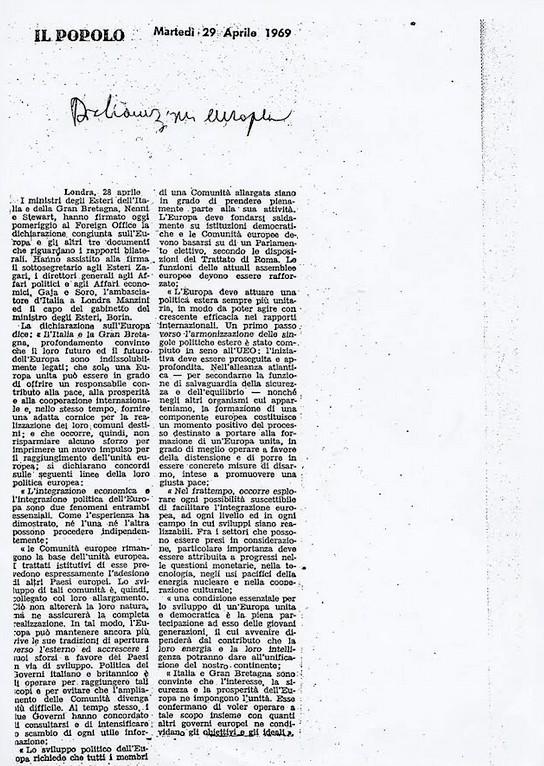
The diplomatic action that led to the Joint Declaration, signed by Nenni and Stewart at the Foreign
Office on the afternoon of 28 April 1969, was preceded by repeated interventions by Zagari at
meetings and debates on Europe — in Paris in 1966, in Florence before the Hamilton Foundation, and in
a lectio magistralis at the University of Pavia on 9 May 1967, in which he traced the
political and economic reasons Britain had once held back from Europe, and the shift — accelerated by
a weakening of Britain's world role — that had brought it to apply.
As Guido Colonna di Paliano, Commissioner for the Internal Market, observed in January 1967: Britain,
"despite being very advanced in research and technology," could not exploit that advantage
commercially while remaining outside the Community. These themes fed into The European
Challenge, the book Zagari published in April 1968 in close collaboration with Counsellor Mario
Magliano, then Head of his Cabinet — a month, as it happened, before the occupation of the Sorbonne
and the events of May '68 in France.
1. The elaboration of the Joint Declaration began with conversations between Zagari — constantly
accompanied by his Head of Cabinet — and Lord Alun Chalfont, drawing on Chalfont's own reference, in an
interview of 22 February 1969, to George Brown's 4 July 1967 statement to the WEU: "The
Community is a dynamic and constantly evolving body… capable of expressing its point of view and
exerting influence in world affairs, not only trade and economy but also politics and defence."
2. At the WEU Council in Luxembourg on 6–7 February 1969, chaired for Italy by Nenni with
Zagari at his side, Nenni argued that the WEU could make "a real contribution to European integration."
France reserved its position on every substantive point; the Five nonetheless held together. Stewart
and Nenni, discussing tactics afterward, agreed that when President Saragat visited London in April
"there should be a joint announcement of all that the British and Italians were doing to show that
they 'saw eye to eye' on the future of Europe." Nenni told the Council: "if we do not have the courage
to reach concrete forms of political integration, then the process of economic integration will also
be blocked." Gaston Thorn, Pierre Harmel and Joseph Luns each praised his intervention.
3. The Italian Embassy in London, under Ambassador Raimondo Manzini, became a hub for these
exchanges. At a series of meetings on 6 March 1969, Italian and British figures — including
Giorgio La Malfa, Giovanni Malagodi, Carlo Russo and Enrico Ferri on the Italian side — took the
measure of how far Britain had travelled: away from the "great open sea" of empire, from sterling's
role as a reserve currency, and toward a pragmatism that would ease negotiation. That same day, Zagari
met Foreign Secretary Michael Stewart to discuss the shape of the coming Declaration. Zagari asked
whether Italy and Britain might set out a political starting point covering not only entry but also
defence and currency, thereby confronting de Gaulle with his own responsibilities. Stewart replied
that a "blueprint of Federation" did not appeal to the British, who preferred concrete things —
technology, defence procurement — over "a vague federalism," and asked what Italian public opinion
made of federalism. Zagari stressed the importance of an elected, empowered European Parliament as a
check on an otherwise uncontrolled European technocracy. It was agreed the Declaration would be
finalised at diplomatic level in Rome. Later that day, Tony Benn told Zagari: "technology is our key
to the future; it is the tool to bring the old England of the industrial revolution into 2000; but it
is also a precious passport to enter the Common Market."
4. From these talks came the lines that would form the text of the Declaration: that economic and
political integration were both essential; that enlargement would not alter the Communities' nature
but ensure their full realisation; that the Communities must rest on an elected Parliament; that the
WEU initiative on harmonising foreign policy must be deepened; that a European component within the
Atlantic Alliance could help build a Europe capable of working for détente and disarmament; that
monetary and technological progress mattered; and that the future of European unification depended on
the full participation of the young.
5. The historian Melissa Pine, in Harold Wilson and Europe (Tauris, 2007/2012), records
that while Italy and the Netherlands had previously said they would prevent developments within the EC
that would impede enlargement, "the Anglo-Italian Declaration was the first instance of a formal
written agreement to this effect." Wilson, she writes, saw in President Saragat's April visit "an
opportunity to reinforce the impression of the sincerity and determination underlying his application
to the EC and build an important alliance." The commitment to consult and exchange information, she
notes, meant that Britain would in effect gain "a voice, albeit indirect, in the internal discussion
of the Community."
6. On 11 March 1969, at the Fourteenth Session of the Jean Monnet Action Committee for the
United States of Europe in London, procedural constraints kept Zagari from delivering a prepared
speech — but its substance was carried into the Committee's final resolution, which held it "essential
without delay to find solutions to the problems of the British entry into the Common Market," and
equally necessary "to seek ways of achieving the political integration of Europe including Great
Britain."
7. A visit by Lord Chalfont to Rome was fixed for 11 April 1969, with officials — Roberto
Gaja for Italy, Patrick Hancock for Britain — set to finalise the text within two weeks, ahead of
President Saragat's state visit.
8. At that Rome meeting, Zagari set out Italy's position in a toast: economic, social and
democratic crises alike, he argued, could only be resolved through enlargement, since "it is the
nature of things that now requires Great Britain to join the European construction." He named four
principles — democratic control by an elected European Parliament, participation by youth and
workers; the inclusion of money and technology as drivers of integration; the harmonisation of foreign
policy through consultation; and a defence dimension capable of giving Europe a voice for détente and
security.
9. The British government's regard for this joint work is evident in two letters sent to Zagari
by Ambassador Shuckburgh on 8 April 1969. Michael Stewart wrote by hand: "I would be grateful if
you would tell Signor Nenni how grateful I am for the staunch support for Britain's entry into the
Community." Lord Chalfont wrote in similar terms, as did George Brown, from the House of Commons,
days earlier.
10. Melissa Pine devotes considerable attention to the "Soames Affair" of February–April 1969,
in which General de Gaulle's private overture to the British Ambassador in Paris, Christopher Soames,
was made public and provoked a bitter dispute with France. Ambassador Shuckburgh in Rome pressed the
Foreign Office not to deal with Paris "behind the back of the Italians." In the event, no trace of
this Franco-British friction appears in the record of the Anglo-Italian negotiations themselves.
Those present at the final meetings recalled Harold Wilson turning to Nenni with striking courtesy:
"the leadership is yours, we shall follow" — to which Nenni replied, "we must do the impossible for
Europe." Even as Saragat privately observed that "de Gaulle is not immortal," the Declaration itself
struck a respectful note toward France, and upon de Gaulle's resignation — announced the very day of
the signing — both Saragat and Nenni sent messages honouring his service to the free world.
11. On 6 May 1969, at a session in London marking the twentieth anniversary of the Statute of
the Council of Europe, Zagari reaffirmed the commitment "unswervingly to the widening of the European
Economic Community," a fact, he said, "not only of an economic nature" but "a political fact of far
reaching scope."
12. Historical credit for the Declaration's drafting belongs in part to John Robinson of the
Foreign Office's "Official Committee on the Approach to Europe," who — as historian Paolo Craveri
records — "substantially contributed to the drafting of the Anglo-Italian Declaration, being able to
accept suggestions from the Italian side," including, notably, the clause on direct elections to the
European Parliament, first pressed by Zagari in his April toast to Lord Chalfont.
13. Of the British ministers involved, the essay singles out George Brown as the Declaration's
true architect — the author, in November 1968, of a remarkable fifteen-page memorandum proposing a
"second Messina Conference," open to all European states, to negotiate a new treaty establishing a
European political community with competence over foreign affairs, defence, technology, currency and
culture; a Parliament with real budgetary and executive oversight; a second chamber on the model of
the American Senate; and a joint aid fund, peace corps and youth exchange programme. Conceived over
half a century ago, the essay notes, this memorandum feels strikingly topical after Brexit.
"We are witnessing a truly 'boomerang of history.' Do the British citizens know today that the
United Kingdom entered the European Community on 1 January 1973 after a persevering political
and diplomatic support offered above all by Italy, starting from the presentation of the second
candidacy on 10 May 1967?"